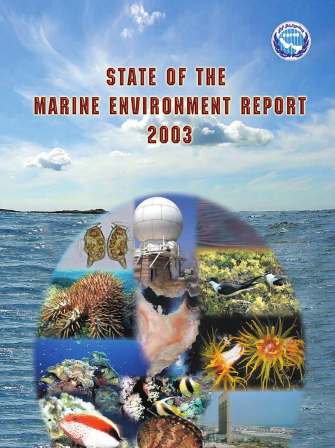
Summary of SOMER 2003

Filters
Filters
Publication Date

2003

Issue

2003

The State of the Marine Environment Report (SOMER) 2003, prepared by the Regional Organization for the Protection of the Marine Environment (ROPME), provides a comprehensive and updated assessment of the environmental conditions of the ROPME Sea Area (RSA). The report builds on earlier editions (1999 and 2000) and is based on contributions from member states, scientific studies, oceanographic surveys, and international collaboration.

Objectives and Scope

The report aims to:

Assess and document the current state of the marine and coastal environment. Identify major environmental concerns and emerging issues. Propose regional strategies and priority actions to support sustainable development and informed decision-making.The RSA, located in the northwestern Indian Ocean, includes three main zones: the inner Gulf, the Gulf of Oman, and the outer Arabian Sea region. Each zone has distinct physical and ecological characteristics.

Major Environmental Issues

The region faces significant environmental pressures resulting from rapid development, industrialization, and population growth. Key challenges include: Marine and coastal habitat degradation due to land reclamation, dredging, and urban expansion. Declining water quality from untreated sewage, industrial discharges, and land-based pollution. Oil pollution, with approximately 1.2 million barrels spilled annually, makes hydrocarbon levels among the highest globally. Overfishing, destructive fishing practices, and loss of biodiversity.

Introduction of invasive species and ecosystem imbalance. Thermal pollution from desalination and power plants. Pollution and Contamination Pollution in the RSA originates from multiple sources:Industrial effluents (petrochemicals, refineries, desalination plants).Sewage discharges, often untreated or partially treated.Atmospheric emissions from industries and vehicles.Oil spills and tanker operations.

Monitoring studies show:

Persistent oil contamination with slow environmental recovery. Presence of trace metals and organic pollutants, with localized “hotspots.” Generally low but notable levels of POPs, PCBs, and pesticides. Unusual high concentrations of arsenic in some marine organisms and cadmium accumulation in fish, requiring further research.

Environmental Characteristics The RSA is characterized by extreme environmental conditions: High temperatures (up to 49°C) and high salinity (up to 42% or more). Strong winds (especially Shamal) causing dust storms and sediment deposition. Low rainfall and high evaporation rates. Complex circulation patterns driven by density, evaporation, and inflow from the Strait of Hormuz. These conditions influence nutrient distribution, biological productivity, and ecosystem dynamics. Marine Resources and Biodiversity Despite harsh conditions, the RSA hosts diverse marine ecosystems: Coral reefs adapted to extreme environments but highly vulnerable. Seagrass beds and mangroves (mainly Avicennia marina) supporting biodiversity. Rich fisheries, though declining due to environmental stress. Significant populations of marine turtles, seabirds, and marine mammals (including globally important dugong populations). Over 85 marine and coastal sites have been designated or proposed as protected areas. Socio-Economic Pressures Economic activities heavily impact the marine environment:

Coastal development, tourism, and infrastructure projects.

Oil and gas extraction and transportation.

Desalination and power generation.

Fisheries exploitation and maritime transport.

These activities contribute to habitat destruction, pollution, and ecosystem stress.

Major Accidents and Events

The region has experienced severe environmental damage from wars and oil spills:

The Iran-Iraq War and the 1991 Gulf War caused massive oil discharges (over 9 million barrels in 1991 alone).

Oil fires and spills created long-term ecological damage.

Shipwrecks and ongoing maritime risks continue to threaten the environment.

Conclusion and Recommendations

The report emphasizes the urgent need for:

Strengthened regional cooperation and environmental governance.

Continuous monitoring and data collection.

Pollution control and sustainable resource management.

Public awareness and stakeholder engagement.

SOMER 2003 serves as a critical reference for understanding environmental trends and guiding future policies to protect the marine environment of the ROPME Sea Area.
  • Coastal ecotourism
    Coastal ecotourism

    This publication issued by the Regional Organization for the Protection of the Marine Environment (ROPME), as part of Marine Environment Series (5), addresses Coastal Ecotourism on the occasion of Regional Environment Day (24 April 2015). It highlights ecotourism as a key instrument for sustainable development and coastal environmental protection. The newsletter emphasizes that coastlines are

  • Encroachment on beaches and its impact on the safety of the coastal environment
    Encroachment on beaches and its impact on the safety of the coastal environment

    This publication, part of the Marine Environment Series (No. 11) issued by the Regional Organization for the Protection of the Marine Environment (ROPME), addresses the issue of coastal encroachment and its impact on the integrity of the coastal environment. It highlights the ecological and economic significance of beaches as dynamic ecosystems rich in biodiversity, essential

  • Green economy
    Green economy

    This publication addresses the concept of the green economy as a key modern approach in environmental and development thinking. The term emerged prominently through the United Nations Environment Programme (UNEP) in 2008 and was globally recognized as a central pillar of sustainable development, particularly during the Rio+20 Conference. A green economy is defined as an

  • Guidelines for the Preparation of National Report on the State of the Marine Environment
    Guidelines for the Preparation of National Report on the State of the Marine Environment

    The document titled “Guidelines for the Preparation of National Report on the State of the Marine Environment” (ROPME, 2007) provides a structured framework for Member States to prepare national reports that contribute to the regional State of the Marine Environment Report (SOMER). Developed in collaboration with UNEP and aligned with the GEO (Global Environment Outlook)

  • Mangrove Trees
    Mangrove Trees

    This special publication, issued on the occasion of Regional Environment Day (April 24, 2012), highlights the significance of mangrove trees as one of the most vital and productive coastal ecosystems. It provides a comprehensive overview of their environmental, historical, scientific, and economic importance, with particular focus on their status within the Regional Organization for the

  • Marine Environment Series: Marine Pollution from Offshore (sea-based) sources
    Marine Environment Series: Marine Pollution from Offshore (sea-based) sources

    This special publication from the Marine Environment Series (2020) addresses marine pollution from offshore (sea-based) sources, focusing on the marine environment within the Regional Organization for the Protection of the Marine Environment (ROPME) area and the growing environmental challenges driven by human activities, particularly those linked to oil, shipping, and industrial development. The ROPME marine

  • Marine Plastic Pollution: Challenges and Solutions in the ROPME Sea Area
    Marine Plastic Pollution: Challenges and Solutions in the ROPME Sea Area

    The eighth issue of the Marine Environment Series published by the Regional Organization for the Protection of the Marine Environment (ROPME) addresses marine pollution caused by plastic waste as one of the most critical environmental challenges facing the world’s oceans, including the ROPME Sea Area. The report emphasizes that plastic pollution is more persistent and,

  • MOOPAM (2010)
    MOOPAM (2010)

    A revised edition for the guide to the fieldsurveys, sampling and analytical methods to beused by the participating institutions forimplementation of the Monitoring and ResearchProgramme for analyses of oceanographicparameters and oil and non-oil pollutants in theROPME Sea Area. In this revised edition of MOOPAM severalconsiderations were taken into account, i.e. thedevelopment of analytical capabilities in

  • Offshore Environment of the ROPME Sea Area after the War-Related Oil Spill: Results of the 1993–94 Umitaka-Maru Cruises
    Offshore Environment of the ROPME Sea Area after the War-Related Oil Spill: Results of the 1993–94 Umitaka-Maru Cruises

    The publication “Offshore Environment of the ROPME Sea Area after the War-Related Oil Spill: Results of the 1993–94 Umitaka-Maru Cruises” presents a comprehensive scientific assessment of the marine environment in the ROPME Sea Area (RSA) following the environmental catastrophe caused by the 1990–1991 Gulf War oil spill. The RSA, bordered by eight countries (Bahrain, Iran,

  • Overview on Land-based Sources and Activities Affecting the Marine Environment in the ROPME Sea Area
    Overview on Land-based Sources and Activities Affecting the Marine Environment in the ROPME Sea Area

    A comprehensive overview of land-based sources and activities affecting the marine, coastal and associated freshwater environments in the ROPME Sea Area, including the status of activities dealing with the protection of those environments from land-based sources. This work is based on a review of the relevant information and activities of the individual countries making up

  • Policy brief on the impacts of Climate change on the ROPME Sea Area
    Policy brief on the impacts of Climate change on the ROPME Sea Area

    This policy brief issued by the Regional Organization for the Protection of the Marine Environment (ROPME) assesses the impacts of climate change on the ROPME Sea Area, one of the warmest and most environmentally extreme marine regions in the world, encompassing the Arabian Gulf and the northwestern Indian Ocean. The report confirms that climate change

  • The Guidelines for the Management of Industrial Wastewater for the ROPME Region (2005)
    The Guidelines for the Management of Industrial Wastewater for the ROPME Region (2005)

    The Guidelines for the Management of Industrial Wastewater for the ROPME Region (2005) provide a comprehensive framework for controlling and reducing industrial pollution in the marine environment of the ROPME Sea Area (RSA). Due to the semi-enclosed nature of this region, pollutants tend to persist longer, making effective wastewater management a critical environmental priority. The

Explore More
  • SOMER 1999
    SOMER 1999

    The Regional Report of the State of the Marine Environment (SOMER), published by the Regional Organization for the Protection of the Marine Environment (ROPME) in 1999, represents the first comprehensive scientific assessment of the marine and coastal environment within the ROPME Sea Area (RSA). Prepared in accordance with the Kuwait Regional Convention, the report evaluates

  • SOMER 2013 Summary Report for Decision Makers
    SOMER 2013 Summary Report for Decision Makers

    SOMER 2013 is a landmark study in Kuwait’s environmental history. It transformed the understanding of Kuwait Bay’s ecosystem from a general concern to a data-driven reality. It set a precedent for systematic environmental reporting and remains a critical reference document for environmental impact assessments and research papers to this day

  • SOMER 2003
    SOMER 2003

    SOMER 2003 is a landmark study in Kuwait’s environmental history. It transformed the understanding of Kuwait Bay’s ecosystem from a general concern to a data-driven reality. It set a precedent for systematic environmental reporting and remains a critical reference document for environmental impact assessments and research papers to this day