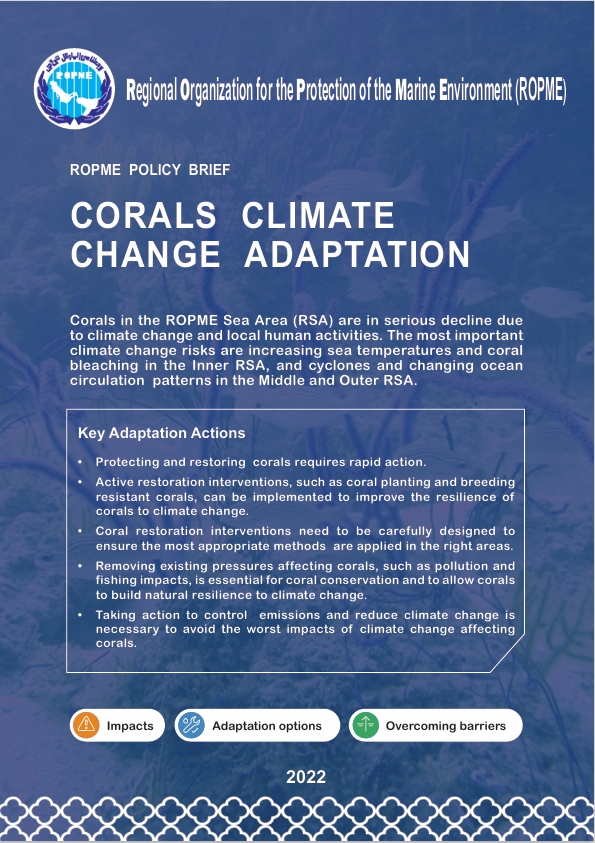


The ROPME Policy Brief (2022) on Coral Climate Change Adaptation examines the severe decline of coral reefs in the ROPME Sea Area (RSA) due to combined pressures from climate change and human activities. The region hosts over 2,000 km² of coral reefs, supporting rich biodiversity and providing significant socio-economic benefits, including fisheries and tourism.
Climate change poses major threats, particularly rising sea temperatures causing widespread coral bleaching in the Inner RSA, and increasing cyclones, storms, and changing oceanographic conditions in the Middle and Outer RSA. Projections indicate that most coral reefs in the region could face critical risk by 2050, with over 70% already lost in the Inner RSA.
Human pressures—including coastal development, pollution, desalination discharges, overfishing, and unsustainable tourism—further weaken coral resilience by degrading water quality and damaging reef structures. These combined stressors reduce the ability of corals to recover and adapt to climate change.
The brief emphasizes a dual approach to adaptation: enhancing natural resilience and implementing active restoration measures. Key actions include improving fisheries management, regulating coastal development, reducing pollution, and establishing marine protected areas. Nature-based solutions, such as mangroves and coastal vegetation, are also highlighted for their role in improving water quality and supporting reef health.
Active restoration techniques—such as coral transplantation, coral gardening, larval propagation, artificial reefs, and innovative methods like shading and cooling—can strengthen local reef resilience but require careful planning, appropriate site selection, and significant resources. These interventions are most effective when combined with broader efforts to reduce greenhouse gas emissions and manage existing environmental pressures.
The report concludes that urgent, coordinated regional action, enhanced research, and knowledge sharing are essential to protect coral ecosystems and ensure their long-term sustainability under climate change.