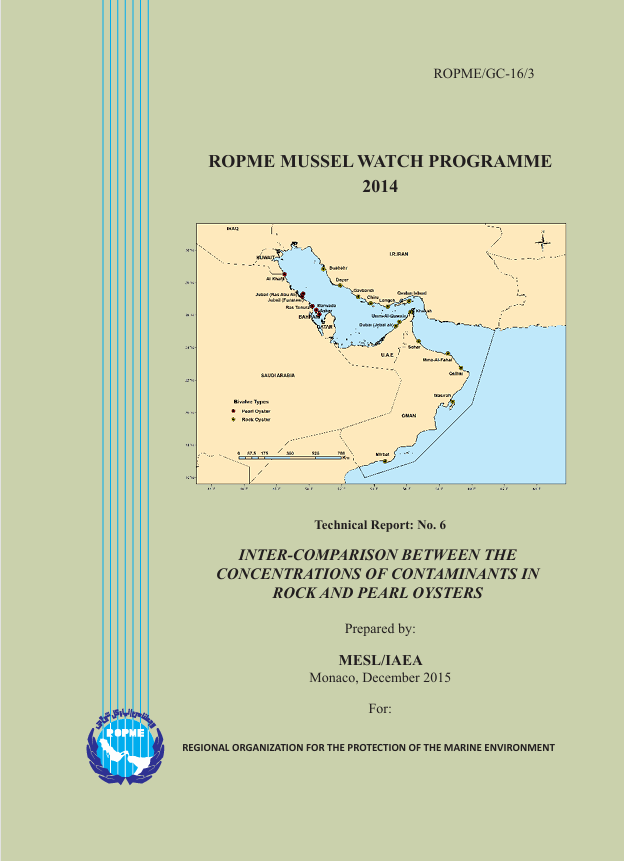


As part of the ROPME Mussel Watch Programme 2014, a specialized study was conducted to compare the concentrations of environmental contaminants in two oyster species used in the regional monitoring programme: Rock Oyster and Pearl Oyster.
This study was undertaken to address one of the scientific challenges within the ROPME Sea Area (RSA), where no single oyster species occurs throughout all Member States. Consequently, two different oyster species have been used in environmental monitoring programmes. Since each species inhabits a different environment, the study aimed to evaluate the extent to which these habitat differences influence contaminant accumulation within their tissues, thereby ensuring the reliability of comparisons among environmental monitoring results across the region.
Objectives of the Study
The study aimed to:
Compare the accumulation capacity of Rock Oysters and Pearl Oysters for trace elements and organic contaminants.
Evaluate the influence of environmental and biological differences between the two species on environmental monitoring results.
Determine whether monitoring results obtained using two different oyster species can be reliably compared.
Support the development of a standardized scientific methodology for future environmental monitoring programmes in the ROPME region.
View moew
Study Scope and Sampling Locations
The study was carried out in Umm Al-Quwain, United Arab Emirates, the only location within the ROPME region where both oyster species coexist, providing an ideal opportunity for direct comparison.
The study included:
- Collection of surface sediment samples from two coastal stations.
- Collection of Rock Oyster and Pearl Oyster samples from the same locations.
- Preparation of three composite samples for each oyster species, with each composite sample consisting of 20 individual oysters.
- Marine sediment samples were also analyzed to characterize their physical and chemical properties and to relate these characteristics to contaminant accumulation in oysters.
Importance of the Study
This study is significant because it helps to:
Improve interpretation of regional environmental monitoring results.
Distinguish between environmental influences and biological differences affecting contaminant accumulation.
Enhance the reliability of oysters as bioindicators of marine pollution.
Support environmental management programmes and science-based decision-making.
Analytical Methodology
The study employed advanced analytical techniques available at the IAEA Marine Environment Laboratories, including:
- Analysis of trace elements in sediments and oysters.
- Measurement of petroleum hydrocarbons.
- Analysis of Polycyclic Aromatic Hydrocarbons (PAHs).
- Determination of organochlorine pesticides.
- Analysis of Polychlorinated Biphenyls (PCBs).
- Determination of lipid content in oyster tissues.
- Comparison of contaminant concentrations before and after normalization to lipid content to improve comparability between the two oyster species.
Main Findings
First: Marine Sediments
The analyses showed that sediments at the study sites consisted almost entirely of sand, with only very small proportions of silt and clay.
Concentrations of trace elements, hydrocarbons, and organic contaminants were within the expected ranges for the study sites. Furthermore, sediment data provided an important scientific basis for interpreting differences in contaminant accumulation between the two oyster species.
Second: Trace Elements in Oysters
The study found that Rock Oysters consistently exhibited substantially higher concentrations of Silver (Ag) and Copper (Cu).
Relatively elevated Zinc (Zn) concentrations were also observed in some Rock Oyster samples; however, this pattern was not consistently found at other monitoring stations and was not clearly supported by previous studies.
Conversely, Pearl Oysters showed relatively higher Cadmium (Cd) concentrations, although the high variability among samples prevented this difference from being considered scientifically significant.
No substantial differences were observed for the remaining trace elements.
The results indicated that the different accumulation patterns of Silver (Ag) and Copper (Cu) represent the clearest and most consistent finding of the study.
Third: Organic Contaminants
The study compared:
Petroleum hydrocarbons.
Polycyclic Aromatic Hydrocarbons (PAHs).
Polychlorinated Biphenyls (PCBs).
Organochlorine pesticides, including DDTs and HCHs.
The results showed no statistically significant differences between the two oyster species for most organic contaminants.
A slight increase in certain petrogenic hydrocarbon compounds was observed in Pearl Oysters; however, the limited number of samples and the considerable variability among measurements prevented this difference from being considered conclusive.
Likewise, no significant differences were observed for PCBs or organochlorine pesticides between the two oyster species.
Fourth: Lipid Content
The study demonstrated that Rock Oysters contained significantly higher lipid content than Pearl Oysters.
After normalizing contaminant concentrations to lipid content, some relatively higher concentrations of organic contaminants appeared in Pearl Oysters; however, these increases were not statistically significant because of the large variability among samples.
The report emphasized that differences in lipid content can substantially influence comparison results and should therefore be considered when interpreting environmental monitoring data.
Evaluation of the Findings
The report concluded that biological differences between the two oyster species have little influence on the accumulation of most organic contaminants and trace elements, with the exception of:
Silver (Ag).
Copper (Cu).
For all other contaminants, the study was unable to demonstrate genuine differences in accumulation capacity between the two species, mainly because of the high natural variability among samples and the limited sample size.
Main Conclusions
The report concluded that:
- Rock Oysters exhibited a greater capacity to accumulate Silver and Copper than Pearl Oysters.
- No clear differences were observed for the other trace elements.
- Petroleum hydrocarbons and organochlorine compounds showed no statistically significant differences between the two oyster species.
- Lipid content influences the accumulation of certain organic contaminants and should be considered when interpreting monitoring results.
- Current data remain insufficient to draw definitive conclusions for all contaminants due to the limited sample size and high variability among samples.
Recommendations
The report recommended:
- Conducting dedicated laboratory studies to better understand contaminant accumulation mechanisms in each oyster species, including the effects of metabolism, food availability, physiological condition, and reproductive cycle.
- Increasing sample size and improving the design of future comparative studies.
- Continuing the use of both Rock Oysters and Pearl Oysters in regional monitoring programmes while taking into account species-specific differences in the accumulation of Silver and Copper.
- Further developing regional comparison methodologies to improve the accuracy of marine pollution assessments.
Importance of the Report to the Regional Organization for the Protection of the Marine Environment (ROPME)
This report represents an important reference study supporting the development of regional environmental monitoring programmes by:
- Improving interpretation of Mussel Watch Programme results throughout the ROPME Sea Area.
- Enhancing the reliability of comparisons among Member States despite the use of two different oyster species.
- Supporting the development of more reliable bioindicators for marine pollution monitoring.
- Providing scientific data to support environmental management and informed decision-making.
- Strengthening scientific cooperation between ROPME and the International Atomic Energy Agency in the field of marine environmental monitoring.
Summary
The report confirms that both Rock Oysters and Pearl Oysters serve as reliable bioindicators for monitoring marine contaminants within the ROPME Sea Area, and that differences between the two species are generally limited, except for the greater capacity of Rock Oysters to accumulate Silver (Ag) and Copper (Cu).
The study also demonstrated that the accumulation levels of most other organic contaminants and trace elements do not differ substantially between the two species. However, accurate interpretation of monitoring results requires consideration of differences in lipid content and the biological characteristics of each species.
The report highlights the importance of continuing comparative studies and expanding regional monitoring programmes to improve understanding of contaminant accumulation mechanisms, enhance the accuracy of marine environmental quality assessments, and support the sustainable management of marine resources across the ROPME Member States.