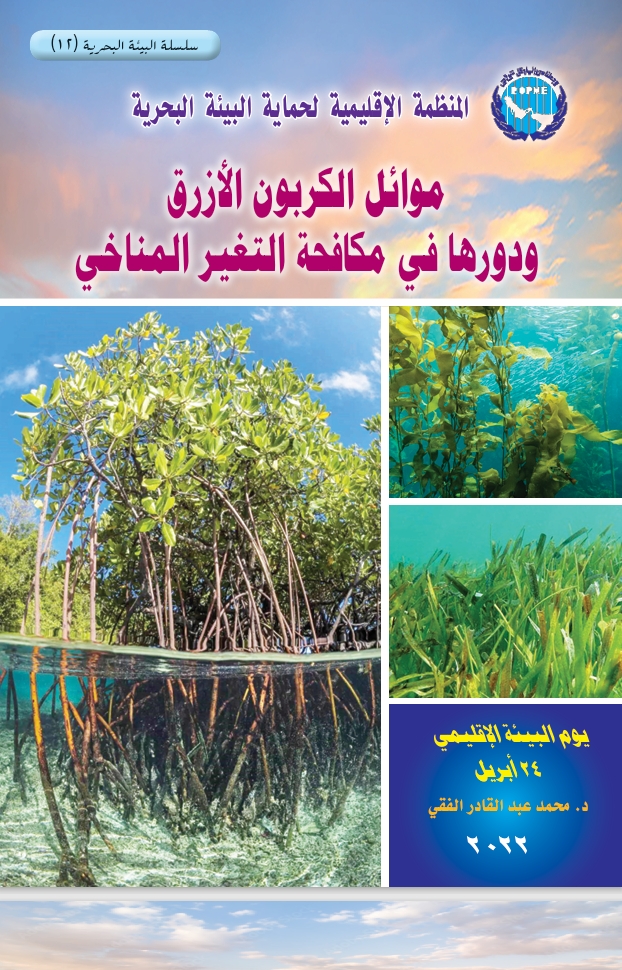


This booklet, published by the Regional Organization for the Protection of the Marine Environment (ROPME) on the occasion of Regional Environment Day (24 April 2022), addresses blue carbon habitats and their role in combating climate change. It highlights their ecological importance and their capacity to absorb and store carbon dioxide.
Blue carbon is defined as carbon captured and stored within coastal ecosystems such as mangrove forests, seagrass meadows, kelp forests (macroalgae), salt marshes, microbial mats, and coastal sabkhas. Although these ecosystems cover relatively small global areas compared to terrestrial forests, they are among the world’s most efficient natural carbon sinks.
Blue carbon ecosystems perform two key functions:
Sequestration of atmospheric CO₂ through photosynthesis
Long-term carbon storage in sediments and biomass, lasting for centuries or even millennia
The booklet emphasizes the link between rising greenhouse gas concentrations since the Industrial Revolution and climate change impacts, including global warming, sea-level rise, ice melting, and increased weather variability.
View more
Key ecosystems include:
Mangroves: Highly efficient carbon sinks storing large amounts in soils and roots, but increasingly threatened by coastal development
Seagrass meadows: Highly productive ecosystems capable of rapid carbon burial and widespread carbon storage
Kelp forests (macroalgae): Highly productive systems that contribute indirectly to carbon cycling and marine food webs
Salt marshes: Among the most efficient ecosystems in long-term carbon storage in sediments
Microbial mats: Small-scale but highly carbon-dense ecosystems
Coastal sabkhas: Significant but under-recognized carbon storage systems in arid coastal regions
The booklet also highlights major challenges. These ecosystems are under severe pressure due to coastal urban expansion, unsustainable aquaculture practices, pollution and overfishing, and climate change itself. Degradation of these habitats can transform them from carbon sinks into carbon sources, exacerbating global warming.
Restoration of blue carbon ecosystems is presented as a critical solution. Restoration can enhance carbon sequestration rates compared to terrestrial forests, strengthen climate change adaptation capacity, protect coastlines from erosion and storms, and support biodiversity and fisheries productivity.
ROPME’s role is central in this effort. The organization develops regional blue carbon mapping, supports climate adaptation and mitigation policies, promotes restoration of coastal ecosystems, builds regional scientific and technical capacity, and integrates blue carbon into regional environmental strategies.
The conclusion stresses that blue carbon ecosystems represent one of the most promising nature-based solutions to climate change. Their effectiveness depends on urgent protection, restoration, and sustainable management. Without action, these ecosystems risk becoming net sources of carbon emissions rather than vital global carbon sinks.