
Rapid Post-Conflict Marine Environmental Assessment in the ROPME Sea Area
Overview
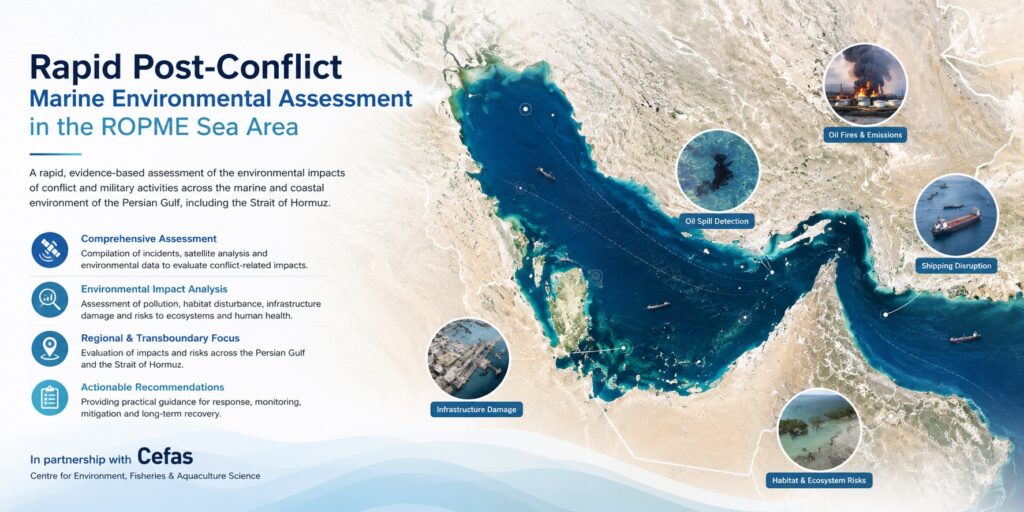
The Rapid Post-Conflict Marine Environmental Assessment in the ROPME Sea Area was implemented by ROPME to assess the environmental consequences of regional conflict and military activity across the marine and coastal environment of the region. The project provided an early evidence-based understanding of conflict-related impacts on marine ecosystems, coastal infrastructure, pollution risks, and essential services such as fisheries, shipping, and desalination. It also supported regional response planning, environmental preparedness, and recovery efforts across the ROPME Sea Area.
Project Objectives
The project was designed to rapidly identify, assess, and map post-conflict environmental impacts across the ROPME Sea Area. Its main objectives were to document conflict-related incidents, assess pollution and habitat disturbance, identify risks to sensitive ecosystems and critical infrastructure, evaluate transboundary impacts, and provide practical recommendations for monitoring, response, and long-term recovery.
Project Approach
The assessment was carried out using a Source–Pathway–Receptor (SPR) framework, allowing the project to examine environmental hazards, how they could spread through the marine environment, and which habitats, services, and communities were most at risk. The work combined incident data, satellite imagery, environmental information, and spatial analysis to produce a regional risk screening of post-conflict marine and coastal impacts.
Main Components
| Component | Description |
|---|---|
| Rapid Situation Assessment | Compilation of conflict-related incidents, environmental pressures, and affected areas using available records, reporting, and historical environmental data. |
| Satellite & Remote Sensing Analysis | Use of SAR and optical imagery to identify oil spills, damaged infrastructure, sediment plumes, and other marine environmental impacts. |
| Sensitivity Mapping | Mapping of sensitive habitats, fisheries, aquaculture areas, and critical infrastructure to identify priority risk zones. |
| Transboundary Risk Screening | Assessment of environmental risks that may spread across national boundaries within the ROPME Sea Area, including pollution, emissions, and shipping disruption. |
| Recommendations & Recovery Planning | Development of response priorities, monitoring needs, and longer-term recommendations for preparedness and environmental recovery. |
This structure allowed ROPME to rapidly identify areas where hazards and sensitive receptors overlapped, helping prioritize response and follow-up action.
Key Outputs
The project delivered a regional overview of conflict-related environmental risks in the ROPME Sea Area, including a compiled record of incidents affecting ships and coastal installations, maps showing the distribution of attacks and affected areas, an environmental impact matrix linking sources and affected marine/coastal zones, an assessment of transboundary risks, and a set of recommendations for coordinated monitoring, mitigation, and preparedness.
Regional Importance
This project strengthened ROPME’s ability to respond to marine environmental emergencies by providing an early regional picture of post-conflict impacts on ecosystems, infrastructure, and essential services. It also highlighted the need for coordinated monitoring, improved baseline information, and stronger regional preparedness for future environmental crises in the ROPME Sea Area.