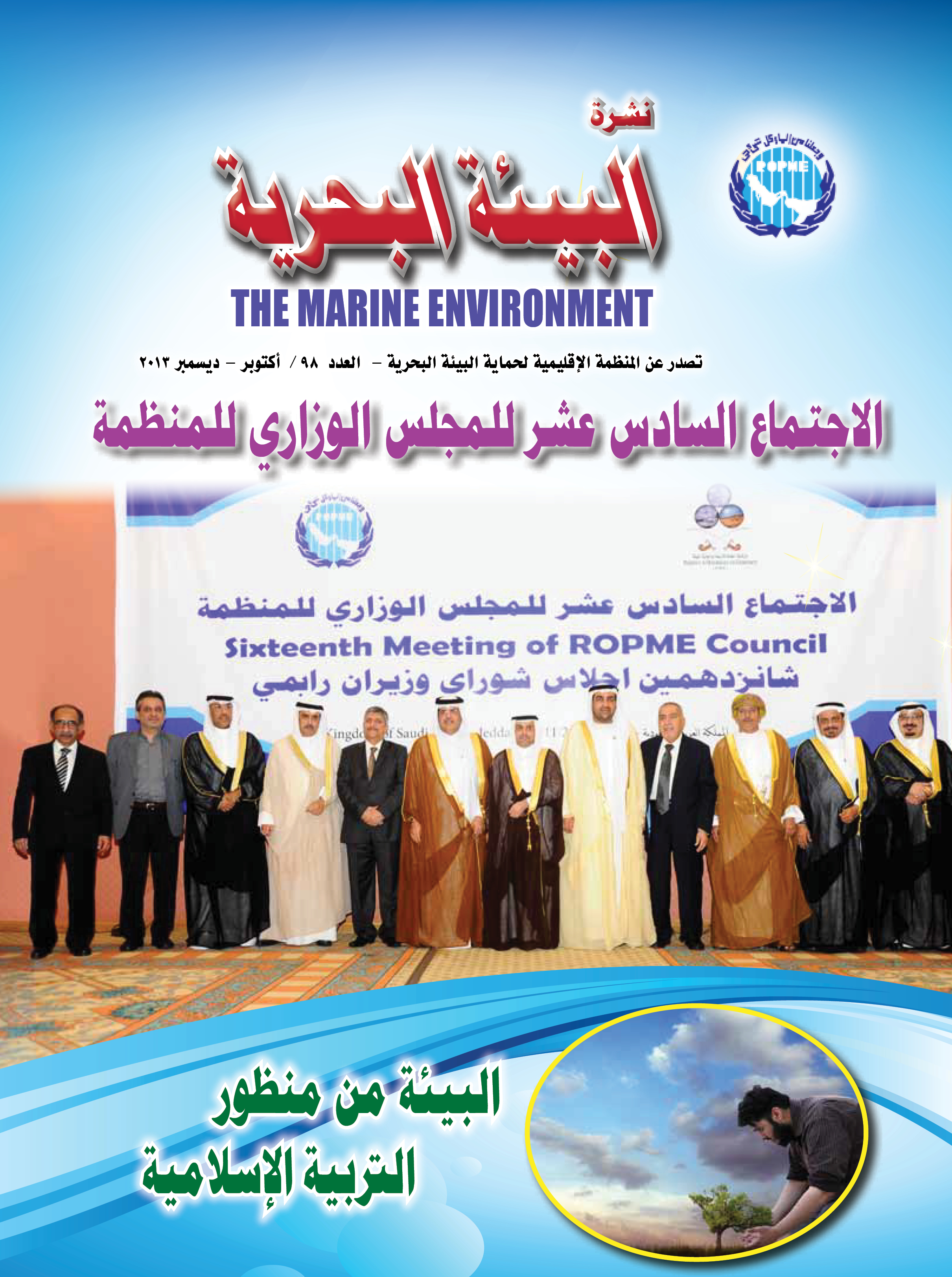


Marine Environment Bulletin, Issue 98 (October–November–December 2013)
- The 16th Meeting of the Organization’s Ministerial Council.
- The Environment from the Perspective of Islamic Education.
A periodic bulletin published by the Secretariat of the Organization; it does not necessarily reflect the views of the Organization or its member states
Advisory Board
Dr. Hassan Mohamadi – Dr. Hassan Al-Banna Awad – Captain Abdel Moneim Al-Janahi – Mr. Ali Abdullah
Editing and Scientific Content
Mohamed Abdelkader Al-Faki
Technical Supervision
Abdulqadir Bashir Ahmed
Administrative Services
Hana Al-Aref – Zubaida Agha – Anan Raj
Title
Al-Jabriya – Block 12 – Street 101 – Lot 84, P.O. Box 26388, Al-Safat, Postal Code 13124, Kuwait Phone: 5312140 – Fax: 25324173 – 25335243
Website: www.ropme.com/.net/.org
E.Mail:ropme@qualitynet.net
Facebook.com/ropme.org
Twitter.com/ropme
Email: memac@batelco.com.bh
Read in this issue:
- Seventeenth Meeting of the Steering Committee of Senior Environmental Officials. p. 4
- The 32nd Meeting of the Organization’s Executive Committee. p. 8
- The 16th Meeting of the Ministerial Council of the Regional Organization for the Protection of the Marine Environment. p. 10
- Key Decisions and Recommendations of the Organization’s Ministerial Council. p. 22
- Threats to Mangrove Trees in the Sultanate of Oman and Ways to Address Them. p. 43
- Environmental emergency response programs for oil spills.
Editorial
Experience is not a science acquired through reading and study, but rather a set of skills honed by experience and time.
That is why experts are sought out by those looking for innovation and for simple solutions to problems that seem difficult to solve.
Experts are the wealth of this world. Without them, both the public and the private sectors would be lost.
For this reason, the Holy Quran recommends consulting those with expertise, for they are the ones with the authority to make decisions, capable of addressing problems and resolving dilemmas, and able to provide the most accurate information and data. Allah, the Exalted, says: “The Most Merciful—so ask about Him one who is knowledgeable” (Al-Furqan 59). Ibn Kathir (may Allah have mercy on him) excelled in his interpretation of this verse, saying: “Seek knowledge from those who are experts and knowledgeable in the matter, then follow and emulate them.” What a magnificent piece of advice this venerable exegete offers us: to consult those with expertise, to turn to them in matters of knowledge, to follow their opinions, and to emulate them by taking them as role models and examples to guide us.
Experts in the field of the environment are the stars of this field. They have accumulated a wealth of knowledge and have mastered the skills of diagnosis and treatment. As soon as you ask one of them about an environmental problem, they will provide you with a comprehensive and thorough analysis and offer you the best and most effective way to address it.
Here at the Regional Environmental Protection Organization, we have experts who are widely recognized and of whom we are proud at the local, regional, and international levels. We take pride in them locally because, like the people of Mecca who know their city best, they are intimately familiar with the local environment and all its nuances—what disrupts its ecological systems and what disturbs the tranquility of its marine environment.
We take pride in them at the regional level because they have extensive experience in managing the organization’s marine area and are well-versed in all of its oceanographic, biological, and environmental characteristics.
We take pride in them on the global stage because they have earned worldwide recognition for their outstanding contributions to preserving the integrity of our planet and for taking every possible measure to halt the imbalance and disruption afflicting its ecological systems—disruptions caused by humanity’s ongoing encroachment on those systems through the pollutants it emits and the waste it discards. The Executive Secretary of the organization is one of these distinguished experts. He championed the environment in Kuwait at a time when the term “environment” was unfamiliar to many. Since his participation in the Stockholm Conference on the Environment in 1972, his prolific environmental contributions have been unceasing: the establishment of the first non-governmental public-benefit association for environmental protection in the Arab world in 1974, followed by the establishment of the Regional Organization for the Protection of the Marine Environment, and then …. and so on. His contributions continue to this day.
Our experts at the Organization and in its member states are our true treasures. We are proud of them and deeply appreciate their role in protecting our environment.
Yes, we appreciate the enthusiasm of young people. But at the same time, we recognize the immense experience that experts possess. The more years they accumulate, the greater their wisdom and knowledge become. How beautifully the Arab poet put it:
O Bow, do not improve it Do not spoil it; give the bow to its maker
May God grant us success.
Editorial Team
The 17th Meeting of the Steering Committee of Senior Environmental Officials
At the kind invitation of the National Focal Point of the Kingdom of Saudi Arabia, the 17th Meeting of the Steering Committee of Senior Environmental Officials (SESCOM-17) of the Organization’s member states was held at the Conference Palace in Jeddah from November 25 to 26, 2013. The meeting aimed to review the status of implementation of the decisions of the 15th session of the Organization’s Ministerial Council and to issue recommendations regarding the Organization’s program activities for the period from October 2013 to December 2015.
Attendees:
The meeting was attended by officials responsible for environmental affairs from the Organization’s member states, as well as a delegation from the General Secretariat and experts working at the Organization, as follows:
- Kingdom of Bahrain
Dr. Mohammed Mubarak bin Dina, Executive Vice President – Supreme Council for the Environment
Mr. Mirza Salman Khalaf – Director of the Department of Environmental Planning and Assessment – Supreme Council for the Environment
Mr. Abdulqader Saeed Khamis – Director of the Biodiversity Department – Supreme Council for the Environment
- The Islamic Republic of Iran
Dr. Abdul-Razzaq Karbasi – Deputy Director of the Marine Environment Division – Ministry of the Environment
Ms. Farnaz Shouei – Advisor, Marine Environment Division – Ministry of the Environment
- Republic of Iraq
Mr. Taha Yassin Mohammed – Director General of the Southern Region Environment Directorate – Ministry of the Environment
Mr. Qasim Mahmoud Bahram – Legal Advisor – Ministry of the Environment
Dr. Malik Hassan Ali Al-Nasser – Director General – Marine Science Center, University of Basra
Prof. Ali Abdulrasul Da’bul – Marine Sciences Center, University of Basra
Dr. Abdulkarim Taher Yasser – Deputy Director General – Marine Sciences Center, University of Basra
Mr. Jassim Abdulhussein Jbour – Director of Marine Environment – Southern Region Environment Directorate – Ministry of Environment
- State of Kuwait
Mr. Hamza Abbas Karam – Director of the Water Pollution Monitoring Department – Environment Public Authority
Mr. Faisal Boualyan – Head of the Water Pollution Monitoring Division – Environment Public Authority
- Sultanate of Oman
Ms. Thuraya bint Saeed Al-Sirri – Director of the Biodiversity Department – Ministry of Environment and Climate Affairs
Mr. Ahmed Mohammed Ahmed Al-Habsi – Head of the Marine Pollution Control Division – Ministry of Environment and Climate Affairs
Mr. Abdullah bin Ali Al-Saqri – Director of the Environment and Climate Affairs Department, Al-Dakhiliyah Governorate, Ministry of Environment and Climate Affairs
Dr. Ali Hassan – Senior Environmental Expert – Ministry of Environment and Climate Affairs
- The State of Qatar
Hussein Saad Al-Kubaisi, Engineer – Head of the Safety and Risk Assessment Division – Ministry of the Environment
- Saudi Arabia
Dr. Abdulbasit Al-Sirafi – Deputy Director General for Environment and Sustainable Development and Director General of Natural Resources – General Directorate of Meteorology and Environmental Protection.
Dr. Khalid Al-Otaibi – Director General of the Nuclear Safety Committee – General Presidency of Meteorology and Environmental Protection.
Mr. Ziad Mohammed Dagistani – Director of Marine Resources – General Directorate of Meteorology and Environmental Protection
Dr. Hatem Al-Mutairi – Assistant Undersecretary for Environmental Affairs – General Presidency of Meteorology and Environmental Protection
Mr. Hamdan Al-Ghamdi – General Presidency of Meteorology and Environmental Protection
Mr. Saleh Omar Saleh Al-Maghribi – Environmental Protection Specialist – Coastal Zone Management Department – General Presidency of Meteorology and Environmental Protection
Mr. Abdulhadi Al-Omari – Director General of Natural Resources – General Presidency of Meteorology and Environmental Protection.
- United Arab Emirates
Dr. Salem Rashid Salem Al-Hassani – Member of the Executive Committee for Maritime Security – Office of His Excellency the Deputy Supreme Commander of the Armed Forces.
Mr. Mohammed Obaid Al Zaabi – Director of the Environmental Disaster and Emergency Management Department – Ministry of Environment and Water.
Mr. Mohammed Khamis Al-Kaabi – Director of the Executive Committee for Maritime Security – Executive Committee for Maritime Security.
- General Secretariat of the Regional Organization for the Protection of the Marine Environment
His Excellency Dr. Abdulrahman Abdullah Al-Awadi – Executive Secretary of the Organization
Dr. Hassan Mohammadi – General Coordinator of the Organization
Dr. Hassan Al-Banna Awad – Marine Environment Expert at the Organization
Dr. Muthian Thangaraja—Marine Environment Expert at the Organization
Mr. Ali Abdullah – Administrative Officer at the Organization
Mr. Mohammed Ali Al-Tamimi – Administrative Supervisor at the Organization
- Maritime Emergency Mutual Assistance Center
Captain Abdulmoneim Mohamed Al-Janahi – Director of the Maritime Emergency Mutual Assistance Center (MEMAC).
Opening Ceremony:
The meeting opened at 9:30 a.m. on Monday, November 25, 2013, with remarks by His Excellency Dr. Abdulrahman Abdullah Al-Awadi, Executive Secretary of the Organization, in which he welcomed the participants, and expressed his sincere appreciation to the Kingdom of Saudi Arabia and the General Presidency of Meteorology and Environmental Protection for their generous hospitality and the excellent arrangements for the meeting.
His Excellency provided a brief overview of the state of the marine environment and the key challenges facing the Organization’s marine region that need to be addressed collectively. Among these, he mentioned: the problem of urban growth in coastal areas, coastal erosion, habitat destruction, industrialization, desalination plants, accidental oil spills or those resulting from maritime operations, threats posed by invasive alien species, the requirements of balanced water management, the risks of nuclear radiation, increasing maritime traffic, loss of biodiversity, and global warming. His Excellency called on Member States to engage in full partnership and to commit wholeheartedly to making every possible effort to address all aspects of these challenges.
His Excellency Dr. Al-Awadi also addressed the issue of delays in the payment of financial contributions by member states, which affects the Secretariat’s ability to continue its environmental programs related to the protection of the marine environment.He highlighted the issue of member states failing to provide the Secretariat with the necessary reference information regarding measures taken within their countries that are relevant to the Organization’s programs, a situation that limits the Secretariat’s ability to develop these programs. In conclusion, His Excellency thanked the attendees, welcomed them once again, and expressed his hope for the success of the meeting.
Election of the Chair and the Secretary:
Subsequently, in accordance with the procedures and regulations of the Regional Organization for the Protection of the Marine Environment, Dr. Abdulbasit Al-Sirafi of the host country was unanimously elected Chair of the meeting, and Mr. Abdulqader Saeed Khamis of the Kingdom of Bahrain was elected Secretary of the meeting. Dr. Al-Sirafi welcomed the members of the Steering Committee of Senior Environmental Officials and wished them a successful meeting. He also thanked His Excellency Dr. Al-Awadi for his opening remarks.
Adoption of the agenda:
The committee members discussed the agenda items and approved and adopted the items listed therein. The delegation of the Kingdom of Saudi Arabia proposed retaining the title of the “Leading Member States” program in environmental fields. The delegation of Iraq expressed its concerns regarding the fluctuating and decreasing discharge rates of the Shatt al-Arab and the resulting impacts on the ecosystem.
The delegation also proposed the development and implementation of an action plan regarding the flow of water from the Shatt al-Arab. The participants welcomed a proposal to include the issue of Shatt al-Arab water discharge in the organization’s future programs and recommended exploring the possibility of holding a meeting between Iran, Iraq, and Kuwait, with the participation of relevant United Nations bodies, to draft an action plan on this matter.
Review and discussion of the report of the Organization’s General Secretariat:
The meeting participants then began discussing the programs and activities carried out by the Regional Organization for the Protection of the Marine Environment. The delegation from the Organization’s Secretariat presented a report on the implementation of the decisions of the 15th session of the Organization’s Ministerial Council, as well as the proposed activities for the Organization’s program for the years 2013–2014 – 2015. This report included details on the following topics:
• Environmental monitoring and assessment programs
• Environmental management programs
• Supporting activities and programs
• Activities of the Maritime Emergency Mutual Assistance Center.
• Regional and international cooperation.
• Member states that are leaders in specific environmental fields.
• Summary of the organization’s financial report and proposed budget.
The meeting participants discussed in detail all activities of the Organization’s program for the years 2013–2014–2015 and made the appropriate amendments. They issued the recommendations reached for presentation to the 30th meeting of the Organization’s Executive Committee.They also recommended holding the 18th meeting of the Steering Committee of Senior Environmental Officials in the Kingdom of Bahrain in December 2015.
The 32nd Meeting of the Organization’s Executive Committee
The Executive Committee of the Regional Organization for the Protection of the Marine Environment held its 32nd meeting in Jeddah, Saudi Arabia, on Wednesday, November 27, 2013. The meeting was chaired by His Excellency Dr. Rashid Ahmed bin Fahad, Minister of Environment and Water of the United Arab Emirates and current Chair of the Organization’s Executive Committee. In addition to His Excellency, the meeting was attended by:
- Dr. Abdulaziz bin Omar Al-Jasser
Director General of Meteorology and Environmental Protection in the Kingdom of Saudi Arabia.
- His Excellency Dr. Abdulrahman Abdullah Al-Awadi
Executive Secretary of the Regional Organization for the Protection of the Marine Environment.
- Dr. Adel Khalifa Al-Zayani, representing His Highness Sheikh Abdullah bin Hamad Al Khalifa, President of the Supreme Council for the Environment of the Kingdom of Bahrain.
- Dr. Abdolreza Karbasi, representing Her Excellency Dr. Masoumeh Ebtekar, Vice President of the Islamic Republic of Iran and Head of the Environmental Administration of the Islamic Republic of Iran.
The meeting was also attended by the General Coordinator, experts, and technical staff from the Organization’s General Secretariat, as well as the Director of the Maritime Emergency Mutual Assistance Center.
Opening of the meeting:
The meeting was opened by His Excellency Dr. Rashid Ahmed bin Fahd, who welcomed the members of the Executive Committee and wished them a successful meeting. He expressed his deep appreciation to the Kingdom of Saudi Arabia in general, and to His Excellency Dr. Abdulaziz bin Omar Al-Jasser in particular, for the warm welcome and excellent hospitality. He also thanked the members of the Organization’s Steering Committee for their efforts and for the outcomes and recommendations resulting from their 17th meeting.
For his part, His Excellency Dr. Abdulrahman Abdullah Al-Awadi, Executive Secretary of the Organization, thanked the Kingdom of Saudi Arabia for its hospitality and for the arrangements it had made to host the meetings of the Organization’s Steering Committee and Executive Committee in Jeddah. He expressed his deep gratitude to His Royal Highness Prince Turki bin Nasser bin Abdulaziz, former Chairman of the Organization’s Ministerial Council, for his kind invitation to host the Organization’s meetings and for his continued support.
He expressed his regret over his illness and wished him a speedy recovery and good health. He also thanked Dr. Abdulaziz bin Omar Al-Jasser and his colleagues at the General Presidency of Meteorology and Environmental Protection for the excellent arrangements and facilities provided for the meeting. He spoke of his hope that conditions would improve to provide better protection for the organization’s marine area in the coming years.
Dr. Adel Khalifa Al-Zayani then delivered a speech in which he conveyed the greetings of His Highness Sheikh Abdullah bin Hamad Al Khalifa and his best wishes for success to the members of the organization’s Executive Committee, expressing his regret at being unable to attend. He also wished Dr. Abdulaziz Al-Jasser every success in the duties entrusted to him.
Dr. Al-Zayani raised a number of issues for discussion at the meeting, proposing a review of the organization’s personnel management system, a reassessment of member states’ financial contributions, and the development of a long-term strategy to reorient the organization’s programs.
Dr. Abdul-Razzaq Karbasi then took the floor, congratulating His Excellency Dr. Al-Jasser on his new appointment and expressing his gratitude to him and to the Kingdom of Saudi Arabia for their warm welcome and generous hospitality. Dr. Karbasi emphasized the importance of holding international conferences on environmental challenges in the Organization’s region of operation at regular intervals and recommended that a decision be made in this regard.
Dr. Abdulaziz bin Omar Al-Jasser thanked all members of the Executive Committee for their remarks and wished them every success in their meeting. His Excellency emphasized the need for a collective response to the regional environmental challenges facing the Organization’s maritime region and called on all member states to support the Organization’s program activities in order to achieve its intended objectives.
The Executive Committee then reviewed the organization’s program activities for the fiscal years
2013–2014–2015. It discussed new issues raised by representatives of the Kingdom of Bahrain, the Islamic Republic of Iran, and the Kingdom of Saudi Arabia. It also reviewed the recommendations issued by the Steering Committee of Senior Environmental Officials of Member States at its 17th meeting, decided to approve them, and referred them to the Organization’s 16th Ministerial Meeting.
The 16th Meeting of the Ministerial Council of the Regional Organization for the Protection of the Marine Environment
The 16th meeting of the Ministerial Council of the Regional Organization for the Protection of the Marine Environment was held in Jeddah, Saudi Arabia, on November 28, 2013, attended by the ministers responsible for environmental affairs in the organization’s member states and representatives of those states (the Kingdom of Bahrain, the Islamic Republic of Iran , the Republic of Iraq, the State of Kuwait, the Sultanate of Oman, the State of Qatar, the Kingdom of Saudi Arabia, and the United Arab Emirates).
The Regional Authority for the Conservation of the Environment of the Red Sea and the Gulf of Aden (PERSGA) participated as an observer, along with experts and technical staff from the General Secretariat of the Regional Organization for the Protection of the Marine Environment.The main objective of the meeting was to review the status of implementation of the decisions of the 15th session of the Organization’s Ministerial Council and to consider the Organization’s program activities and budget allocations for the fourth quarter of 2013 and the fiscal years 2014 and 2015, as recommended by the Organization’s Executive Committee at its 32nd meeting.
Opening Ceremony
The opening ceremony began with a recitation of verses from the Holy Quran. His Excellency Dr. Rashid Ahmed bin Fahad, former Chair of the Ministerial Council, then delivered the opening address, in which he welcomed the distinguished participants to the 16th Regular Meeting of the Ministerial Council. He expressed his deep appreciation to the Kingdom of Saudi Arabia for its warm welcome and excellent hospitality. He also thanked the members of the Organization’s Steering Committee for their efforts and for the outcomes and recommendations resulting from their 17th meeting. He thanked the Organization’s Executive Committee for its efforts during its 32nd meeting and for reviewing the Organization’s program activities and valuable recommendations.
He also extended special thanks to all member states and the Organization’s Secretariat for the spirit of cooperation and support they demonstrated during his tenure as Chair of the Council. He then invited His Excellency Dr. Abdulaziz Omar Al-Jasser to chair the meeting in his capacity as the representative of the host country, noting that he had been unanimously elected to that position following his nomination by Dr. Adel Khalifa Al-Zayani, representative of the Kingdom of Bahrain.
Remarks by Dr. Al-Jasser:
His Excellency Dr. Abdulaziz Omar Al-Jasser, President of the General Authority for Meteorology and Environmental Protection in the Kingdom of Saudi Arabia, delivered a speech at the opening ceremony. The text of his speech is as follows:
Your Highnesses, Excellencies, Ministers, and Delegations
His Excellency the Executive Secretary of the Organization
Your Excellencies, members of the delegations of the Organization’s member states
Brothers and sisters in attendance:
First, on behalf of the Kingdom’s delegation, I would like to once again welcome you to your second home, the Kingdom of Saudi Arabia. I would also like to thank the members of the delegations who participated in the meetings of the Steering Committee of Senior Experts from the Member States of the Regional Organization for the Protection of the Marine Environment over the past few days in preparation for this meeting. Their lengthy and substantive discussions demonstrated and reflected the Member States’ deep concern for their marine environment.
It is perhaps fitting that we take this opportunity to reflect on the decades-long journey the Kingdom has dedicated—represented by the General Presidency for Meteorology and Environmental Protection since its establishment—to upholding the fundamental principles of environmental conservation. Today, anyone following environmental affairs can see that they have become a top priority for the government of the Custodian of the Two Holy Mosques, may God preserve him, based on the Basic Law of Governance, which stipulates this in its main articles, for environmental protection and the mitigation of the impacts of weather phenomena are a commitment and a legislative, social, economic, and ethical imperative, and they are an integral part of sound development and planning in successive five-year development plans.
The Kingdom has given special attention to the environment by enacting legislation and laws governing environmental affairs in general and the marine environment in particular. Since the marine ecosystem is considered one of the most sensitive ecosystems, this necessitates the adoption of strong actions, measures, and legislation to address it under the umbrella of the General Environmental System, which was issued by Royal Decree No. M/34 dated 28/7/1422 AH, thereby providing the legal and regulatory basis for establishing procedures, rules, and principles to regulate all activities affecting the marine environment at the national level. For example, work is underway to develop an integrated coastal zone management plan aimed at developing and protecting coastal areas, and guiding development uses in an integrated manner that ensures the principle of sustainable development, and to establish a mechanism for implementing this plan to coordinate among relevant coastal stakeholders, thereby ensuring compatibility and resolving conflicts in land uses and activities, and preventing duplication in coastal land uses by adopting precise environmental standards and criteria for various activities with the aim of conserving and protecting marine resources.
The Kingdom is a founding member and partner of a number of regional and international organizations and bodies dedicated to the protection of the marine environment, including the Regional Organization for the Protection of the Marine Environment, where it has participated in developing action plans under the organization’s purview. The Kingdom has also signed numerous protocols related to the protection of marine biodiversity in both the Red Sea and the organization’s area of operation.
Despite the achievements made, there remains a need for greater attention and commitment to protecting the water body shared by our countries, through the Organization, in order to achieve the objectives for which the Organization was established and to implement the roadmap prepared for this purpose.
Your Highnesses, Your Excellencies, Ladies and Gentlemen:
The Kingdom of Saudi Arabia has made significant strides in implementing the 21st Century Agenda. Since the Agenda was adopted in Rio de Janeiro in 1992, the Kingdom has been studying this global framework and has adopted a national agenda that is currently being implemented, with progress reviewed annually. This continuous monitoring of implementation has had a significant impact on enriching the Kingdom’s many achievements in the field of sustainable development, which have encompassed economic, social, and environmental aspects, and whose effects are clearly evident in the health and educational lives of Saudi citizens.
These achievements also included the implementation of numerous structural reforms, the continued pursuit of economic and financial stability, the improvement of service delivery, and the expansion of vocational and technical education—which led to an increase in women’s participation in education and employment opportunities, a rise in life expectancy, the enactment and development of regulations, the establishment and development of development and environmental institutions, and capacity building.
The Kingdom maintains constant communication with regional countries and developed nations regarding the transfer of modern technologies related to environmental protection. We also look to the international community to support our efforts to manage marine resources sustainably, especially since urban expansion and urban housing projects are linked to the availability of basic services—interrelated challenges that require regional and international efforts, to which the Kingdom has dedicated financial and human resources as well as active political support.
The Kingdom’s government has placed great importance on water, its development, and conservation, given the scarcity of its resources due to its geographical location within arid and semi-arid regions characterized by low rainfall. To meet growing demand, the government has turned to the sea by expanding the use of seawater desalination technology and adhering to strict environmental standards through the construction of desalination plants that utilize multi-stage flash distillation to produce both water and electricity, and reverse osmosis to produce water only. Furthermore, treated wastewater is considered one of the most important sources of water for secondary uses, in addition to the primary source, which is groundwater, whether renewable or non-renewable.
In closing, I pray to God that this venerable organization will continue on its path as it has since its inception, and achieve the noble goals for which it was established.
Peace be upon you, and may God’s mercy and blessings be upon you…
Remarks by the Executive Secretary of the Regional Organization for the Protection of the Marine Environment
His Excellency Dr. Abdulrahman Abdullah Al-Awadi, Executive Secretary of the Regional Organization for the Protection of the Marine Environment, delivered the following speech at the opening of the Organization’s 16th Ministerial Meeting:
Your Excellencies, Members of the Council
Ladies and Gentlemen
It is my pleasure and honor to meet with you at the 16th Regular Meeting of the Ministerial Council of the Regional Organization for the Protection of the Marine Environment, held in Jeddah, Saudi Arabia, under the gracious patronage of the Kingdom. We are all grateful and appreciative of the warm welcome, generous hospitality, and valuable efforts made by the Government of the Kingdom. We are also particularly grateful to His Excellency Dr. Abdulaziz Omar Al-Jasser and his colleagues at the General Presidency of Meteorology and Environmental Protection for their valuable support, and the excellent arrangements made to facilitate and ensure the success of the successive meetings held by the Steering Committee of Senior Officials for Environmental Affairs at its 17th session, the Organization’s Executive Committee at its 32nd session, and the Ministerial Council at its 16th meeting, which is being held today. I would like to take this opportunity to thank the Organization’s member states for their active participation in these meetings, their commitment to reaching appropriate recommendations and decisions, and their success in doing so.
Dear Participants:
The fifteenth meeting of the Organization’s Ministerial Council issued a number of resolutions concerning the Organization’s program activities within the framework of the Kuwait Action Plan. It is my pleasure to report to you today that, thanks to the full cooperation of Member States and close collaboration with a number of regional and international organizations, the Organization has pursued the implementation of these resolutions with the utmost seriousness. We deeply appreciate the invaluable support we have received from you. We also appreciate the contributions we have received, without which our work would have been much more difficult. The Ministerial Council is scheduled to meet today to review the progress made in implementing the decisions of the 15th session of the Ministerial Council and to decide on the priorities of the Organization’s program.I am pleased to present to you here some of the achievements made in this regard:
- The SOMER report on the state of the marine environment has become a key reference document on marine environmental protection for the organization’s area of operation. The text of the 2013 report has been finalized to be partially aligned with the methodology used in the UNEP-GEO Global Environment Outlook report, and it will be published shortly after the regional review meeting. Its executive summary, titled “Sustainability Message to Decision-Makers,” has already been published.
- The first phase of the regional program for monitoring shellfish was successfully implemented with the participation of member states. Final reports on the results of the survey of concentrations of trace metals, organic pollutants, and organotin compounds have been published. The final report on radionuclides will be published shortly.
- The fourth edition of the MOOPAM guide (Modern Methods for Monitoring and Analysis of Pollutants) has been published, featuring a new chapter on the analysis of radionuclides and four additional procedures. A special edition of the MOOPAM guide on radiation will also be published.
- A survey and monitoring of selected radionuclides, such as cesium-37 (Cs-37), lead-210 (Pb-210), potassium-40 (K-40), uranium-238 (U-238), and uranium-235 (U-235), were conducted in the region’s marine environment for the first time. It was recommended that the radiation history of the Organization’s marine area be re-examined.
- Ten technical reports and two studies on the results of the 2006 winter research cruise have been published in accordance with the organization’s standard format. The remaining two technical reports and three additional studies will be published shortly.
The findings from the winter research vessel expedition and the organization’s other research efforts have paved the way for a better understanding of the state of the marine environment in the region. Overall, the results indicate that the level of pollution in our marine environment is low and within acceptable limits, with the exception of a few sites suffering from chronic localized pollution.
- An international conference on environmental challenges in the Organization’s maritime region, hosted by the National Focal Point in the Islamic Republic of Iran, was successfully held. The conference proceedings were published, and several selected scientific papers were published in an international journal. There is a recommendation to hold international and regional conferences of a similar nature on a regular basis, rotating among the Organization’s member states.
- Steady progress has been made in priority areas of maritime emergency preparedness, response, and readiness, particularly in the fields of training and capacity building. However, the establishment of reception and treatment facilities remains a major challenge. What is concerning is the duality in this regard: while there is full recognition of the region’s need for such facilities, there is no specific timeline for action. Our discussion of this topic may seem repetitive, but the need is urgent and essential, requiring us to reiterate and emphasize the importance of beginning the construction of these facilities and ensuring that every State with oil ports in the region implements comprehensive environmental monitoring procedures for tankers entering the Organization’s maritime zone, and to renew the momentum and spirit of cooperation to implement the Organization’s protocol on this matter, so that the level of response to maritime emergencies improves and we succeed in protecting our fragile marine environment.
Dear Brothers:
In the same vein, as we discuss our achievements, it is important to highlight some emerging environmental issues
which concern us and require our collective efforts to address:
- It pains us to observe the unprecedented levels of pressure our coastal areas are facing as a result of increasing socio-economic activities. In fact, the appeal of our region’s coastlines for economic activities fundamentally conflicts with the concept of sustainability and environmental conservation. A balance must be struck between development needs and environmental sustainability.
Our coastal areas face significant threats, including unregulated dredging, excavation, and beach filling for coastal development projects. Such activities negatively impact mangrove ecosystems, coral reefs, seagrass beds, estuaries, and tidal zones. The situation is fraught with contradictions: while we work to develop our coastal areas, we are simultaneously altering and destroying their habitats through our actions, ignoring environmental impacts and the fundamental principles of sustainability and integrated coastal zone management. Of particular concern is the large amount of new materials introduced into our natural environment, along with the changes we have made to the composition of our coasts, the depths of these coasts, their water distribution cycles, and the fragmentation of their ecosystems.
The prudent management of coastal development projects must be achieved by applying the principles of “Integrated Coastal Area Management (ICAM)” and by consistently treating this as a high priority. We need to address this challenge with sincerity, fresh thinking, collective efforts, and political consensus, as this issue affects the economic interests and development priorities of our region.
- Taking into account the various dimensions of climate change has become a central focus of all the organization’s program activities in the region. The specter of global warming, rising sea levels, the loss of wetlands, the degradation of biodiversity, the invasion of alien species, and inadequate legislation to provide effective protection for the marine environment—all these are alarming indicators. The shallow sedimentary basin of the Organization’s internal marine area is facing significant temperature changes. Several effects of climate change have already begun to appear; 2008 witnessed numerous incidents of coral bleaching within this basin. Major cyclones, such as Gonu in 2007 and Phet in 2010, have become more frequent. Reports of coastal erosion have been received, underscoring the need for caution and urgent action to address this problem. More broadly, climate change is also leading to a major water crisis in the region. Pressure on desalination plants could cause seawater to become saltier and warmer. The degradation of the mangrove ecosystem also has numerous long-term impacts, such as a decline in fish stocks and other marine living resources. This calls for the urgent adoption and implementation of the Regional Protocol on the Conservation of Biodiversity and the Establishment of Protected Areas, as it will provide answers to many questions regarding species loss, mass mortality of marine life, habitat degradation, and the threat of invasive alien species. In addition to the above, the establishment of an integrated environmental monitoring system modeled after the Global Ocean Observing System (GOOS) through shared ownership of its components is also an urgent necessity and a driving force for the creation of an early warning system for the region.
Dear Participants:
The main purpose of my remarks today is to assess the achievements and outline the challenges facing our maritime region, and to propose priorities for the future. Nevertheless, I feel compelled to express my deep concern regarding a number of issues that affect the implementation of the Organization’s program. Perhaps the most significant cause for concern is the increase and accumulation of overdue or unpaid financial contributions to the Organization’s budget by some Member States. The rates of overdue annual contributions have risen higher than ever before, and their payment has been significantly delayed.
We are also concerned about the delay in some Member States’ response in providing us with information regarding their feedback on the activities we are carrying out. Furthermore, the inadequacy of the inputs provided to us constitutes one of the main obstacles to some of our activities and programs, including, but not limited to: the State of the Marine Environment Report (SOMER), the survey program on major onshore activities, and the survey program on marine sources of pollution.
The implementation of the Organization’s activities is a shared responsibility; it requires the full commitment of Member States to address these important issues with due attention, to strengthen confidence in the Organization’s program, and to support our joint efforts to protect the environment in the region.
Your Excellencies, distinguished members of the delegations:
Despite the brief remarks made earlier, I remain, as always, optimistic about your presence and confident in your support, cooperation, guidance, and wisdom. I am pleased to express my gratitude and appreciation for your attendance and participation in the 16th Regular Meeting of the Organization’s Ministerial Council. Your presence is the best proof of your moral support for us, and we need that in our efforts to improve environmental quality in the Organization’s area of operation. I take this opportunity to reiterate our hopes for deepening cooperation with Member States, as well as with numerous regional and international organizations and other stakeholders concerned with the safety of the marine environment. It is also my duty to thank the members of the Steering and Executive Committees for their efforts, their continued support, and their valuable guidance, which will contribute to our implementation of this Council’s decisions.
Finally, it is my honor—on my own behalf and on behalf of the Organization’s Ministerial Council—to express my deepest appreciation and gratitude to the Government of His Majesty the Custodian of the Two Holy Mosques for its patronage and for hosting this important event. We are particularly grateful to His Excellency Dr. Abdulaziz Omar Al-Jasser for his efforts, as well as for the support, assistance, and facilitation provided by him and his colleagues at the General Presidency of Meteorology and Environmental Protection to ensure the success of the Organization’s three meetings, and for the logistical arrangements they made during those meetings.
I pray to God to bless your noble efforts to preserve and protect the environment. I also pray that He guide your steps, grant you continued safety and security, and shower you with His blessings, for He is All-Powerful and worthy of all supplications. Peace be upon you, and may God’s mercy and blessings be with you.
Remarks by the Representative of the Islamic Republic of Iran
The opening ceremony included a speech by Dr. Masoumeh Ebtekar, Vice President and Head of the Environmental Administration of the Islamic Republic of Iran, which was delivered on her behalf by Dr. Abdolreza Karbasi, Deputy Head of the Marine Environment Division at the Environmental Administration. The following is the text of the speech, translated into Arabic:
Their Excellencies the Ministers
Ladies and gentlemen,
Peace be upon you, and may God’s mercy and blessings be upon you
Their Excellencies the Ministers
Distinguished participants
On behalf of the Government of the Islamic Republic of Iran, I would like to express my gratitude to the Government of the Kingdom of Saudi Arabia for hosting the 16th Regular Meeting of the Ministerial Council of the Regional Organization for the Protection of the Marine Environment and the related preparatory meetings, namely the 17th Steering Committee Meeting and the 32nd Executive Committee Meeting. I would also like to take this opportunity to express my sincere appreciation to His Excellency Dr. Abdulaziz bin Omar Al-Jasser, President of the General Authority for Meteorology and Environmental Protection of the Kingdom of Saudi Arabia, for his support and efforts in organizing this important meeting. I am also pleased to express my sincere thanks and appreciation to His Excellency Dr. Abdulrahman Al-Awadi, Executive Secretary of the Organization, and his colleagues for all their support.My country, the Islamic Republic of Iran, recently held presidential elections in which the overwhelming majority voted for Dr. Rouhani, who called for the adoption of a “moderate” approach, which was the slogan of his election campaign. The election of His Excellency Dr. Rouhani has sparked a new wave of hope and optimism for Iran and the world. Now, following the agreement with the West on the nuclear issue, the intensity of the confrontation between Iran and Western powers has subsided, and sanctions have been eased—a development we hope will bring with it renewed hope for achieving peace and security at both the regional and global levels.
Your Excellencies:
Many of us participated in the 19th session of the Conference of the Parties to the United Nations Framework Convention on Climate Change, held in Warsaw last week. As noted at the conference, we cannot ignore the harsh realities brought about by climate change, which negatively impact our overarching mission of achieving sustainable development for all countries, including those in our region. It is regrettable that we have not addressed this issue in the Organization’s maritime region with the seriousness it deserves. We must find appropriate solutions to mitigate the effects of climate change in our region through the support and cooperation of relevant international organizations.
Dear Participants:
For more than 30 years, we have all been working through the Regional Organization for the Protection of the Marine Environment to take more effective measures to prevent and combat pollution in the Organization’s marine area. Ensuring a sustainable future for the region is one of our most shared concerns and a central focus of the Organization’s activities. However, we continue to face numerous challenges, such as the discharge of various pollutants into this unique marine environment. The time has come to develop a new approach and a specific strategy to address this problem. In this regard, one of the most effective policies for achieving this is to draw up a roadmap to define the strategic path toward our goals.
We are pleased to note that the organization has recently taken positive steps toward this end and has prepared a proposed roadmap; we hope that it will be implemented through cooperation among its member states.
Your Excellencies:
In accordance with the requirements of the Kuwait Convention and its Protocol on the Protection of the Marine Environment from Land-based Sources of Pollution, I am pleased to inform you that the Islamic Republic of Iran has recently established a set of environmental standards to mitigate the impacts caused by the discharge of domestic, agricultural, and industrial wastewater into the marine environment within the Organization’s area of operation. Given the need to coordinate environmental activities among all Member States, I would like to see a special focus on the development of regionally acceptable standards regarding the discharge of pollutants into the Organization’s maritime area, and I hope this will be achieved promptly. It is expected that the Organization will begin paving the way for the implementation of this important requirement.
Dear Colleagues:
The Organization has always played a key role in implementing the Kuwait Plan of Action, which represents a regional consensus on the need to take the necessary measures to move forward with the development, implementation, and enforcement of environmental standards. Nevertheless, facilitating the protection of the marine environment, the rational use of natural resources in the Organization’s maritime region, and the creation of conditions conducive to achieving sustainable social -economic development in each of the Organization’s member states depends heavily on the preparation of a national strategy and action plan for each country individually, reflecting its position on national environmental issues and transboundary pollutants identified at the national level. The national action plans stemming from the Kuwait Convention can be prepared as planning documents for environmental protection activities in the region, with the aim of identifying important environmental issues and prioritizing activities related to addressing these issues. To this end, we expect the Organization to encourage Member States to undertake such efforts.
Your Excellencies:
The economic and health well-being of the people in this region depends on the state of the regional environment and the condition of marine ecosystems. Regrettably, the increase in sand and dust storms caused by the adverse effects of climate change and persistent drought has made our region’s environment more fragile and vulnerable. I therefore call on all member states of the Organization to join the “Regional Action Plan for Cooperation” to form a coalition to effectively address regional environmental challenges. There is an urgent need to establish a permanent secretariat to coordinate and strengthen efforts aimed at protecting the marine environment in the Organization’s area of operation.
In addition, the right of the public—and particularly those affected by environmental impacts—to participate in decision-making processes is now widely recognized in national and international legislation. Therefore, the policy of listening to the public’s views and involving them in the formulation of environmental policy must be one of our priorities. Effective mechanisms must be established to ensure public participation in addressing environmental issues within the organization’s area of operation.
Dear Colleagues:
The establishment of a regional center for biodiversity was decided at the 14th session of the Organization’s Ministerial Council. Since then, the Islamic Republic of Iran has taken a series of comprehensive measures toward this end, but we are still awaiting support from the Organization to launch this center. As Iran is a leading country in the field of biodiversity in the region, it has established a marine animal hospital on Kish Island in partnership with the private sector. I would like to propose the establishment of such centers in other member states. In this regard, the Islamic Republic of Iran can provide invaluable expertise to the countries of the region and can arrange for professional training courses related to this subject for those countries.
Mr. Chairman:
In conclusion, I would like to note that the Organization’s agenda addresses environmental sustainability in the region. It is well known that sustainable development is also at the top of the global agenda. In this regard, we reaffirm our full commitment to the outcomes of the Rio+20 document. Allow me to conclude by noting that the Islamic Republic of Iran supports all efforts aimed at achieving sustainable development in the Organization’s maritime region, and in this context, it urges the Organization to prepare an action plan to achieve sustainable development in the region. I also look forward to continuing to implement environmental standards and policies in the Organization’s area of operation.
Finally, thank you for your attention.
Peace be upon you, and may the mercy and blessings of God be upon you.
Remarks by His Excellency the Iraqi Minister of the Environment – Eng. Taha Yassin Mohammed
The opening ceremony included a speech by His Excellency Mr. Sarkoun Lazar Saliwa, Minister of the Environment of the Republic of Iraq, which was delivered on his behalf by Mr. Taha Yassin Muhammad, Director General of the Southern Region Environment Directorate at the Ministry of the Environment,
The text is as follows:
His Excellency Dr. Abdulaziz bin Omar Al-Jasser, President of the General Directorate of Meteorology and Environmental Protection in the Kingdom of Saudi Arabia; His Excellency Dr. Abdulrahman Abdullah Al-Awadi, Executive Secretary of the Regional Organization for the Protection of the Marine Environment.
Your Excellencies, Ministers, and Deputy Ministers
Ladies and Gentlemen:
It is a great honor to be here today with the Iraqi delegation to address the Council of the Regional Organization for the Protection of the Marine Environment, and we would like to express our deep gratitude to the Kingdom of Saudi Arabia for hosting the 16th meeting of the Regional Organization for the Protection of the Marine Environment.
The future of the Regional Organization’s maritime zone is in our hands, and for that reason, we thank you all for attending this meeting. It has been an exciting year for Iraq, during which significant progress has been made in our understanding and knowledge of the Regional Organization’s marine area for the protection of the marine environment. Great efforts have been made in the areas of local and international resources as well as public relations, and it is certain that this work cannot be accomplished in isolation from others, and we are deeply grateful for these fruitful cooperative relationships with you.
The protection of Iraq’s territorial waters must go hand in hand with efforts to protect the maritime zone of the regional organization. We are deeply grateful for the information provided by our experts and other scientific sources through the Marine Science Center at the University of Basra, as through this research center, Iraq has completed a large body of scientific research that will strengthen and advance scientific research in this field.
The Marine Science Center at the University of Basra has prepared annual reports on the state of the marine environment over the past three years (2011–2013), and last year it produced the final report on the environmental status of regional marine waters, SOMER 2012. In the context of the Regional Organization for the Protection of the Marine Environment (ROPME), the Mussel Watch program—which uses mussels to monitor marine pollution—has been implemented through the Marine Science Center at the University of Basra. This research initiative was encouraged by ROPME, and we plan to continue this work next year.
The Republic of Iraq is pleased to announce the launch of the National Environmental Strategic Plan, which has significant implications for the entire marine area of the Regional Organization for the Protection of the Marine Environment. This plan—along with other economic, social, and development plans—has laid the foundation for our environmental priorities. Furthermore, the draft standards for water quality, including coastal waters, have been finalized, and in the near future, these water quality standards will be implemented to regulate the quality of our inland waters. These steps are of great importance for the protection and management of Iraq’s water resources, and they are also significant for the Regional Organization for the Protection of the Marine Environment.
In the area of radioactive contaminants, Iraq has completed the construction of twenty stations for monitoring nuclear radiation in the environment, four of which have been installed exclusively in Basra Governorate, where they are dedicated to monitoring radioactive contaminants in coastal areas. In addition, we are in the process of preparing a national emergency plan for incidents involving such contaminants in coastal areas, with the aim of better protecting these coastal environments and other inland waters from radioactive activity.
In addition to the above, experts, resources, research, and monitoring form an integrated system at the national level. We are working hard to develop relationships with international organizations, particularly through the efforts of member states of the Regional Organization for the Protection of the Marine Environment (ROPME), and we hope that Iraq will be connected to the marine information network and the early warning system.
Iraq has worked tirelessly to ratify international agreements and protocols related to various environmental issues. Last month, we signed the Minamata Convention in cooperation with our friends in the Islamic Republic of Iran. This international convention is of great importance in protecting our people and our waters from external emissions of mercury and its compounds. There has been excellent cooperation with the Japan International Cooperation Agency (JICA) as well as with the Maritime Emergency Mutual Assistance Center (MEMAC), and through this cooperation, we have been able to finalize the national plan to combat oil spills in our ports. An agreement was signed with GICA to develop a comprehensive national plan for combating oil spills in Iraq, under the supervision of MEMAC and at the invitation of companies specializing in this field. It is very clear that this is an integral part of the efforts to protect the regional organization’s maritime zone.
In the area of national environmental education and awareness, we are pleased to announce the upcoming launch of a national campaign in 2014 (Year of the Environment). This campaign will involve school students, educational institutions, and civil society organizations, and will include various activities such as conferences, workshops, and educational and environmental awareness seminars. Prizes will be awarded for each activity, which will serve to raise environmental awareness in general and environmental awareness specifically among these segments of society.
Although Iraq has accomplished a great deal so far, and we continue to carry out the remaining tasks entrusted to us, relying on the trust placed in us by the Regional Organization for the Protection of the Marine Environment, we still have a lot of work to do.
Iraq possesses experts and researchers who are scientifically passionate and ambitious, and is working on ambitious plans that rise to the occasion; However, we need more than just human resources, as Iraq is one of the poorest signatory states to the Organization and has a very limited coastline of no more than 58 kilometers (less than 1%). To complete these projects, we need financial resources. As the Council is aware, we have submitted a request to the Organization to reduce the contribution paid by Iraq to the Organization for the aforementioned reasons; furthermore, we have requested the release of 40% of Iraq’s previous contributions to enable and support the Marine Science Center at the University of Basra to continue its research activities in this field or through any other means that would allow Iraq to continue its important work in protecting the marine environment from pollutants.
We sincerely thank you for your interest in this matter, which will enable us to move forward with our partners in ambition and passion. We look forward to working hard for the Regional Organization for the Protection of the Marine Environment and in the service of our glorious nations.
Key Decisions and Recommendations of the Organization’s Ministerial Council
Following the conclusion of the opening ceremony, the special session of the 16th meeting of the Organization began with the participation of the following Excellencies and distinguished guests (listed in the alphabetical order used by the Regional Organization for the Protection of the Marine Environment):
1. His Excellency Dr. Adel Khalifa Al-Zayani – Chief Executive Officer of the Supreme Council for the Environment, representing the President of the Supreme Council for the Environment of the Kingdom of Bahrain.
2. His Excellency Dr. Abdolreza Karbasi—Deputy Head of the Marine Environment Division at the Environmental Protection Administration, representing Her Excellency Dr. Masoumeh Ebtekar, Vice President of the Islamic Republic of Iran and Head of the Environmental Administration of the Islamic Republic of Iran.
3. Engineer Taha Yassin Muhammad—Director General of the Southern Region Environment Directorate, Ministry of the Environment—representing His Excellency Mr. Sarkoun Lazar Saliu, Minister of the Environment of the Republic of Iraq
4. His Excellency Dr. Salah Madi Fahad Al-Madi – Chairman of the Board of Directors and Director General of the Environment Public Authority in the State of Kuwait.
5. His Excellency Mr. Mohammed bin Khamis Al-Arymi, Undersecretary of the Ministry of Environment and Climate Affairs of the Sultanate of Oman.
6. His Excellency Mr. Ahmed Amer Mohammed Al-Humaidi—Minister of Environment of the State of Qatar.
7. His Excellency Dr. Abdulaziz bin Omar Al-Jasser—Director General of the General Directorate of Meteorology and Environmental Protection in the Kingdom of Saudi Arabia.
8. His Excellency Dr. Rashid Ahmed bin Fahad – Minister of Environment and Water in the United Arab Emirates.
9. His Excellency Dr. Abdulrahman Abdullah Al-Awadi – Executive Secretary of the Regional Organization for the Protection of the Marine Environment.
This was attended by technical experts responsible for environmental affairs in the member states and the Organization’s Secretariat.
In accordance with Article 13 of the Rules and Procedures of the Organization’s Ministerial Council, His Excellency Dr. Abdulaziz bin Omar Al-Jasser, President General of the Meteorology and Environmental Protection Agency of the Kingdom of Saudi Arabia, chaired the meeting, while His Excellency Dr. Adel Khalifa Al-Zayani, Executive President of the Supreme Council for the Environment of the Kingdom of Bahrain, served as Vice-Chair of the meeting.
Following extensive discussions on the agenda before the Council, the 16th Ministerial Council meeting of the Organization concluded with the approval of the Organization’s programs and activities for the years 2013–2014–2015, after deliberation, and the allocation of the necessary budget for their implementation.
The Council adopted the following important resolutions:
First, Environmental Monitoring and Assessment Programs
1. SOMER Marine Environment Status Report:
The Organization’s Ministerial Council expressed its appreciation for the efforts made in preparing the 2013 State of the Marine Environment Report, which was partially aligned with the methodology used in the UNEP-GEO Global Environment Outlook report. The Council urged the Organization and Member States to strengthen their knowledge partnership in preparing and publishing this report on a regular basis. It decided as follows:
- We would like to express our gratitude to the United Nations Environment Programme – Regional Office for West Asia (UNEP/ROWA) for its ongoing cooperation with our organization and its support for the activities of this program.
- Prepare the next edition of the Marine Environment Status Report so that it differs in its objectives, content, and chapters, following the format of the UNEP-GEO Global Environment Outlook report.
c. Form a specialized team from member states for the SOMER report, whose task will be to provide national inputs, participate in all preparatory work for the report, and draft and finalize it.
d. Collaborating with the Global Environment Facility (GEF) and the United Nations Environment Programme (UNEP), UNESCO, the Regional Organization for the Conservation of the Sea (RECSO), the Islamic Development Bank, and other stakeholders to implement the Transboundary Pollutants Analysis (TDA) project in the area of operation of the Regional Organization for the Protection of the Marine Environment.
(e) Allocate funds for the implementation of the following activities:
– Hold a regional meeting of experts to review the draft 2013 State of the Marine Environment Report.
– The 2013 State of the Marine Environment Report was published in print and electronic formats and on the organization’s website.
– Hold regional meetings of the SOMER Working Group
– Participation in meetings related to the UNEP-GEO Global Environment Outlook report.
– Prepare a Concept Note and a roadmap for the Transboundary Pollutants Analysis (TDA) project in the organization’s area of operation, in collaboration with the Global Environment Facility (GEF), UNEP, UNESCO, REXO, and the Islamic Development Bank.
2. Quality assurance and pollutant monitoring in the Organization’s maritime zone:
A. Expressing gratitude and appreciation for the efforts of the Organization’s member states in their cooperation and full participation in the first round of the regional sampling project for the monitoring of mussels.
B. Requesting Member States to provide the necessary support and participate in the activities of the second round of the regional sampling project for the monitoring of mussels, to be conducted in February 2014.
c. Requesting Member States to improve the performance of environmental measurements by applying best “laboratory practices” in this regard, training key experts in data quality assurance, and participating in quality calibration exercises and tests.
d. Allocate funds for the implementation of the following activities:
– Organize a regional training course for key laboratory staff on the application of analytical techniques to improve measurement accuracy.
– Finalize the MW Shell Monitoring Guide.
– Hold a regional meeting of the Shellfish Monitoring Working Group.
– Prepare a regional biological study on oysters.
– Conducting visits to assess environmental toxicology laboratories in the United Arab Emirates and Jeddah, Saudi Arabia.
– Provide technical support to member states to assist them in participating in the sampling for the shellfish monitoring project during February 2014.
– Technical support for a marine sediment core sampling project aimed at rewriting the history of marine pollution in the region.
– A delegation of experts from the Organization’s member states will visit leading laboratories in those countries to assess their capabilities in the areas of quality assurance and regional-level pollutant monitoring.
– Provide technical support to participating laboratories in the analysis of samples to ensure the quality of the analyses.
– Preparation and development of a guide (Modern Methods for Monitoring and Analyzing Pollutants (MOOPAM) – Radiation Hazards).
– Identify the Organization’s regional reference laboratories.
– The second meeting of the Working Group on the Management of Persistent Organic Pollutants (POPs) in the Marine Environment of the Organization’s Area of Operation was held in cooperation with the National Focal Point of the Islamic Republic of Iran.
– A training program on the analysis of dioxins and furans in the marine environment was held in collaboration with the National Focal Point in the Islamic Republic of Iran.
– Conduct a feasibility study and prepare management and implementation plans for the Organization’s Regional Reference Laboratory, in collaboration with the Global Environment Facility and the Marine Environment Laboratory of the International Atomic Energy Agency (MEL/IAEA).
3. Monitoring factors affecting public health in the organization’s area of operation:
A. Member States should prioritize research into the effects of harmful algal blooms on seawater desalination processes, given the recurring and persistent nature of these blooms in areas adjacent to desalination plants.
(b) That the Organization explore the possibility of coordinating with Member States’ initiatives regarding water desalination and establish an effective mechanism for exchanging data and information in this regard.
c) Participation of the Organization’s member states in UNEP’s Global Partnership on Nutrient Management (GPNM).
d. Allocate funds for the implementation of the following activities:
– Organizing a regional workshop on the Global Nutrient Management Brainstorming (GPNM) initiative for officials responsible for managing harmful algal blooms in the Organization’s member states, in collaboration with the Global Environment Facility and the United Nations Environment Programme.
– Hold a regional expert meeting on the effects of harmful algal blooms on seawater desalination processes.
– The organization should strengthen its interaction and cooperation with the World Health Organization in the areas of water quality and issues related to human health.
4. Protection of fishery resources and sustainable management of those resources:
A. To evaluate the efforts made by the Organization and Member States to respond to emergencies caused by harmful algal blooms using scientific and methodological criteria.
(b) Requesting member states of the Organization to make their national facilities available for the establishment of a mechanism for an early warning network for harmful algal blooms and mass mortality events of marine organisms.
c. Requesting that the Organization’s member states establish national task forces and develop national action plans to mitigate the effects of harmful algal blooms, in accordance with the elements of the regional action plan to address this problem.
d. Requesting that the Organization establish a regional task force to address harmful algal blooms.
(e) Allocate funds for the implementation of the following activities:
– Organizing visits by experts to member states to provide technical advice during harmful algal blooms and mass fish mortality events.
– Regional training on the analysis of biotoxins (biotoxins) resulting from harmful algal blooms.
– Organizing a workshop on the application and modeling of remote sensing techniques to address the problem of harmful algal blooms.
– Implementation of regional projects on the latest research into harmful algal blooms.
– Hold a consultative meeting with the Gulf Cooperation Council and the Islamic Development Bank regarding harmful algal blooms.
5. Remote Sensing Program
(a) Member States shall provide the Organization’s Secretariat, in a timely manner, with the information required for its publications and information services related to the remote sensing program.
b. The Organization should expand its training and capacity-building activities in the field of remote sensing.
c) The Organization shall provide raw data and images to authorized users for the purpose of conducting specific, approved scientific studies in the region.
d. Allocate funds for the implementation of the following activities:
– Collaborating with and supporting member states (the United Arab Emirates and the Sultanate of Oman) in the timely detection and classification of harmful algal blooms.
– A meeting was held for the regional task force on harmful algal blooms in Saudi Arabia.
– Support for the training center at the satellite ground station located in the Organization’s General Secretariat building.
6. Marine survey trips:
A. The organization should expedite the printing and distribution of the remaining technical reports and specialized studies from the winter 2006 marine research vessel expedition.
(b) Requesting Member States of the Organization to continue contributing samples from their marine environments to the Marine Sample Bank of the Organization’s Secretariat.
c. Allocate funds for the implementation of the following activities:
- Develop strategic guidelines regarding the sustainability of the Organization’s maritime zone.
– Provide technical and financial support to relevant national institutions in the Islamic Republic of Iran, the Sultanate of Oman, and the United Arab Emirates for the purpose of conducting a study on water circulation in the Strait of Hormuz.
– Two meetings of the Scientific Committee for the marine research vessel expedition were held during the four quarters of 2016.
– Supporting and developing the marine sample bank at the Organization’s General Secretariat.
7. The Integrated Marine Research, Assessment, and Monitoring Program (IMARP):
A. The Organization shall promote the ecosystem and develop an environmental management approach that serves as a roadmap toward the sustainability of the marine environment, its resources, and its services.
(b) The Organization shall establish a regional working group to identify areas of significance and set priorities regarding climate change, in cooperation with relevant international initiatives.
c. The Organization shall implement a procedure for the baseline assessment of nuclear radiation in its area of operation, ensuring that this assessment follows the model used in the Baseline Assessment of Radiation (BAR) program and includes a study of the radiation history in the Organization’s maritime area.
d. Allocate funds for the implementation of the following activities:
- Organizing regional workshops on the ecosystem-based approach to environmental management, in collaboration with the United Nations Environment Programme.
– Convening meetings of the regional working group on climate change.
– Organized a technical workshop on monitoring and assessing the impact of sand and dust storms (SDS) on the marine environment in the Organization’s area of operation, in cooperation with the National Focal Point in the Islamic Republic of Iran.
– The second meeting of the Regional Scientific Team on the Basic Assessment of Radiation (BAR) was held.
– A regional training program on measuring gamma radiation emitted by marine samples was held.
Second: Environmental Management Programs:
8. Activities to protect the marine environment from pollution caused by land-based sources (LBA):
A. Member States should expedite the completion of the field survey of the most significant onshore activities and provide the Organization with national reports assessing these activities.
b. The Organization shall prepare a working paper on the development of regional standards and requirements for wastewater and gaseous emissions from industrial facilities, based on the results of national monitoring and survey operations.
c. Allocate funds for the implementation of the following activities and events:
– A meeting of regional experts was held to review the status of key activities currently underway in the region.
– Complete the field survey of major onshore activities.
– Prepare an overview of the major activities currently taking place in the region.
– Prepare a working paper on standards for the discharge of wastewater into the marine environment, in collaboration with the National Focal Point in the Islamic Republic of Iran.
9. Activities to protect the marine environment from pollution caused by sources at sea:
A. With regard to the list of chemical products approved by the Organization for use in combating oil spills:
First: Adoption of the following list of oil dispersants for use in the Organization’s area of operations:
DASIC SLICKGONE NS
FINASOL OSR-51
FINASOL OSR-52 / ECOSPERSE 52
OD 4000 (PE 998)
RADIAGREEN OSD
SUPER-DISPERSANT 25
COREXIT 9500
However, the COREXIT EC9500A stock should be used only to treat oil spills at sea and on beaches, and should not be used on rocky shores. The NU CRU stock may continue to be used until its expiration date.
Second: Adopt the following procedures for approving the use of biological agents in the treatment of oil spills:
Until such time as an approved procedure specific to the marine life and conditions of the Organization’s area of operation is established, biological agents are used in the treatment of oil spills based on the approval of three internationally recognized organizations, namely: the Centre for Documentation, Research, and Experimentation on Accidental Water Pollution (CEDRE) in France, the Marine Management Organization (MMO) in the United Kingdom, and the U.S. Environmental Protection Agency. For any biological agent to be included on the Regional Organization for the Protection of the Marine Environment’s list of oil spill response products, it must be listed as a biological treatment agent on the current lists of at least two of the three aforementioned organizations.
(a) The use of non-indigenous organisms in the Organization’s maritime zone is prohibited.
Any biological treatment agents other than fertilizers and nutrients must meet additional requirements and demonstrate validated test results through experimental studies conducted by a specialized regional laboratory under the supervision of the Organization.
B. Extension of the Regional Shellfish Monitoring Program (RMWP) to monitor pollution from marine sources.
c. Allocate funds for the implementation of the following activities and events:
– A workshop on the environmental aspects of offshore operations, in collaboration with the International Petroleum Industry Environmental Conservation Association (IPIECA), the Global E&P Forum, and oil companies operating in the region.
– Organize and conduct a workshop on the implementation of the (Exploration and Production) Protocol and its guidelines.
10. Protecting the marine environment from hazardous waste
A. Urged the national focal points in the Republic of Iraq and the Sultanate of Oman to follow up on this matter with the relevant authorities to expedite ratification of the Protocol on the Control of Transboundary Movements of Hazardous Wastes of Marine Origin.
b. The organization shall liaise and coordinate with the Basel Convention Regional Centers (BCRCs) in the region and beyond for training and technology transfer in the field of hazardous waste.
c. The Organization shall convene a meeting of experts to review all obligations set forth in the Protocol and to prepare a regional action plan and elements of national action plans, including provisions for a monitoring and surveillance system.
D. Allocate funds for the implementation of the following activities and events:
– Organized a regional expert meeting on the principles and requirements of the Hazardous Wastes Protocol, in collaboration with the Basel Convention Regional Center (BCRC).
– Facilitate the implementation of training and technology transfer programs in the field of hazardous waste in the region, in coordination with the Regional Center of the Basel Convention.
e. Update the directory of experts and regional institutions involved in hazardous waste management.
(f) Maintain a special register of waste disposal facilities in the Contracting States.
g. Organizing a workshop on hazardous waste management, in cooperation with the National Focal Point in the Islamic Republic of Iran.
11. Drafting a protocol on the conservation of biodiversity and the establishment of protected areas
(a) Requesting Member States to finalize their national procedures for signing the Protocol and to notify the Organization in advance of their readiness to do so.
b. Request that the National Focal Point in the State of Qatar reconfirm its willingness to host the meeting of the plenipotentiaries for the signing of the Protocol.
c. Allocate funds for the implementation of the following activities:
– A meeting of the commissioners was held to sign the protocol.
– Hold a meeting of experts to develop the components of regional and national action plans for the implementation of the Protocol.
12. The Organization’s Integrated Information System (RIIS)
A. The organization launched the integrated information system and its access protocol in January 2014.
b) The organization should contact centers of excellence in the region to gather information on the experts and expertise available to them for inclusion in the integrated information system.
c) The Organization’s efforts to enhance data and information services for member states through the RIIS system.
d. The Organization shall provide training to Member States on the RIIS system and the related data network.
(e) Allocate funds for the implementation of the following activities:
– Equipment maintenance, system development, and modification of the geographic information system architecture.
– Prepare and develop the second phase of the integrated information system to focus specifically on the application of modeling to ecological systems, and integrate the integrated information system with other information systems.
– Organizing regional training workshops on how to use the new version of the integrated information system.
Third: Supporting Activities and Programs:
13. Environmental Awareness:
A. The Organization shall designate a theme for each year, focusing on a specific topic, and facilitate Member States’ efforts to raise awareness of that theme.
B. Conducting the following activities and events:
– The organization should convene a meeting of technical experts to review and examine
Elements of the Regional Strategy and Action Plan on Environmental Awareness.
– Organizing workshops in member states to raise environmental awareness among journalists
and the media.
– Organizing and conducting workshops (in Arabic and Persian) on new environmental trends for sustainable development, in accordance with the outcomes of the Rio+20 Conference.
– Organizing a regional event focused on environmental films and presenting awards to the winners.
– Prepare a directory of regional experts on the marine environment and publish it on the organization’s website.
– Organizing a regional workshop on emerging environmental challenges in the organization’s area of operation.
– Develop environmental awareness materials, including documents and documentary films, on emerging environmental challenges in the organization’s area of operation.
14. Cooperation between the Regional Organization for the Protection of the Marine Environment and other regional and international organizations:
(a) The Regional Organization for the Protection of the Marine Environment should strengthen and enhance its partnership with regional and international environmental bodies.
(b) Urge Member States—which are not parties to the Ramsar Convention—to seek to accede to the Convention.
c) Allocate funds for participation in regional/international meetings and environmental initiatives.
15. Regional Emergency Planning
Technical assistance:
(a) Providing technical assistance to Contracting States regarding national contingency plans, including support for and participation in oil spill response exercises and related conferences organized by Member States.
b. The Maritime Emergency Mutual Assistance Center (MEMAC) should upload all reports on the committee’s meetings and activities to its website.
Survey on the Oil Pollution Control Audit Program:
(a) Conducting environmental audit programs if requested by Member States, noting that this program is always available to Member States upon request under the technical assistance program of the Center for Mutual Assistance in Maritime Emergencies.
b. Hold the annual meeting of response officers to review the various components of regional and national emergency plans.
c. Organizing the annual meeting of officials responsible for responding to marine pollution incidents to review the various components of regional and national emergency plans.
D. Call on the Organization’s member states to expedite their ratification of the Protocol on Harmful and Noxious Substances (HNS) (2000) to the International Convention on Oil Pollution Preparedness, Response, and Cooperation of 1990 (OPRC), as the Convention has already been ratified by the majority of member states. And urging Member States that are not parties to the 1990 Convention to ratify it as soon as possible.
(e) Member States shall prepare a model emergency plan for hazardous and harmful substances to be incorporated into national oil spill response plans, and shall provide it to the MIMAC Center.
(f) Recognizing the efforts made in preparing the draft regional emergency plan for hazardous and harmful substances, and requesting that member states submit their comments as a matter of urgency in order to finalize the draft, adopt the plan, and begin its implementation.
(g) The Maritime Emergency Mutual Assistance Center (MEMAC) shall prepare a regional guide to hazardous and noxious substances in the Organization’s area of operation once it has completed the regional emergency plan for hazardous and noxious substances.
h. Member states should compile, classify, and establish their own databases on hazardous chemicals, drawing on the experience of Kuwait.
(i) Continuously updating the Regional Guide for Combating Marine Oil Pollution, and republishing and distributing it to all national focal points.
Regional Place of Refuge:
A. The Maritime Emergency Mutual Assistance Center (MEMAC) – in cooperation with the International Maritime Organization (IMO), to commission a group of experts from member states to study the feasibility of designating places of refuge for ships (in cases of distress they may face), in order to implement IMO Resolution A. 949 (23) if it deems it appropriate.
(b) Organize a regional workshop for experts following the International Maritime Organization’s expert mission to review the results of the identification of places of refuge for ships, recognizing that the implementation of this matter is an urgent need for these States.
Iraqi ports and oil loading terminals:
A. Urge the Republic of Iraq to develop a national contingency plan to respond to oil spills that threaten Iraqi oil export terminals, and to treat this as a matter of urgency.
B. The Maritime Emergency Mutual Assistance Center (MEMAC) will support Iraq’s efforts to develop a national contingency plan for responding to oil spills and will begin capacity-building in this area.
Workshops:
A. Organizing and conducting a training program on procedures and operations related to combating marine pollution caused by oil and hazardous and harmful chemicals in the Islamic Republic of Iran.
B. Organizing a workshop on the 1990 International Convention on Oil Pollution Preparedness and Response (OPRC), in cooperation with the International Maritime Organization (IMO) and the International Oil Pollution Compensation Fund (IOPC).
C. Organize a training workshop on protecting desalination plants, power generation facilities, fish farms, mangrove forests, and other coastal infrastructure from oil and other harmful substances.
d. The Maritime Emergency Mutual Assistance Center (MEMAC) will contact the National Focal Point in the State of Qatar to conduct a practical exercise on oil spill emergencies, with the aim of testing the effectiveness of regional arrangements and the national emergency plan.
Path modeling:
A. The Maritime Emergency Mutual Assistance Center (MEMAC) will continue to develop, update, and distribute a model trajectory illustrating how pollutants disperse in the environment.
B. Hold a training workshop on the new version of the model for the dispersion of pollutants in the environment.
16. Application of the Guidelines for Assessing Pollution Damage and the Regional Guide to Compensation Claims:
(a) Member States of the Organization shall nominate qualified representatives from among their ranks to oversee any incident occurring within their territorial waters.
(b) In the event of any incident, Member States shall immediately conduct a study to assess the risks and damages in accordance with their national environmental legislation.
C. The Maritime Emergency Mutual Assistance Center will hold a training workshop on methods for assessing pollution damage, covering damage assessment, evidence collection, sample collection, and claims procedures, in cooperation with the International Maritime Organization (IMO), the International Oil Pollution Compensation Fund (IOPC), the International Tanker Owners’ Federation (ITOPF), and members of the Protection and Indemnity (P&I) Club (GARD).
D. The Maritime Emergency Mutual Assistance Center, in cooperation with Interpol, conducted a five-day training course on investigating pollution violations caused by ships.
(e) The Maritime Emergency Mutual Assistance Center shall update the regional guide on claims for compensation.
17. Establish the MERCU Maritime Emergency Response and Coordination Unit.
A. Adoption of the draft regulations for the Maritime Emergency Response Unit and Coordination of Rescue Operations.
B. Approve the establishment of Maritime Emergency Response and Coordination Centers (MERC) in Kuwait, Bahrain, Bandar Abbas, Fujairah, and the Sultanate of Oman.
c) Member States that host Maritime Emergency Response and Coordination Centers (MERC) shall designate the entity responsible for implementing the project and provide all necessary arrangements and facilities (i.e., land, offices, warehouses, etc. etc., and anything else that can be provided to reduce project costs), as well as permits and information prior to the project’s commencement in each country.
d. By January 2014, the Organization’s Member States shall notify the shipping industry, as well as shipping agencies, of the service fees that must be paid to the Regional Emergency Fund located at the Maritime Emergency Mutual Assistance Center, no later than the end of 2014.
(e) Member States shall incorporate the provisions regarding the maritime emergency response unit system and the coordination of rescue operations into their national legislation.
(f) The Maritime Emergency Mutual Assistance Center (MEMAC) shall submit the relevant documentation for this system to the International Maritime Organization (IMO)/Marine Environment Protection Committee (MEPC), follow up on this matter, and announce the commencement of the implementation phase of the system.
g. The Regional Oil Spill Response Officers (OSROs) and the Maritime Emergency Mutual Assistance Center shall begin defining the terms of reference (TOR) for the project to qualify companies to carry out all aspects of the project to establish Maritime Emergency Response Centers (MERCs).
H. The Maritime Emergency Mutual Assistance Center shall announce the pre-qualification process for companies at the international and regional levels.
(i) The Maritime Emergency Mutual Assistance Center (MEMAC) will arrange visits by experts from member states to the proposed sites of maritime emergency response centers in host countries in order to finalize the construction phase.
(j) Regional Oil Spill Response Officers (OSROs) shall oversee all aspects of the establishment of the Maritime Emergency Response Coordination Unit (MERCU) and coordinate rescue operations.
(k) The Maritime Emergency Mutual Assistance Center (MEMAC), the Regional Oil Spill Response Officers (OSROs), and MEMAC shall invite the relevant official authorities to the regional meeting in each host country of the Maritime Emergency Response Centers regarding the implementation phase.
(l) The Maritime Emergency Mutual Assistance Center held and organized two regional meetings to implement the project to establish the MERCU maritime emergency response and rescue coordination system.
18. Monitoring the status of ports:
A. The Maritime Emergency Mutual Assistance Center (MEMAC) is following up on the Organization’s request to the General Secretariat of the Gulf Cooperation Council to grant the Center observer status under the regional memorandum of understanding on cooperation in port monitoring (the Riyadh Memorandum).
b. The Maritime Emergency Mutual Assistance Center (MEMAC) shall convene a meeting of legal and technical experts, comprising regional oil spill response officers and members of the International Maritime Organization, and Port State Control (PSC) officials from countries in the region, including the Islamic Republic of Iran and the Republic of Iraq, in cooperation with the Secretariat of the Gulf Cooperation Council and the Secretariat of the International Maritime Organization.
(c) Member States of the Organization shall ensure the implementation of the port condition monitoring system by all necessary means, including—but not limited to—close communication among the parties concerned, and shall support and strengthen cooperation in the implementation of the port condition monitoring system in order to enhance regional compliance and strengthen monitoring and surveillance capabilities within the Organization’s area of operations.
19. Periodic reports on maritime emergencies:
A. The Maritime Emergency Mutual Assistance Center shall continue its efforts to prepare periodic reports on oil spills, hazardous and noxious substances, and other maritime emergencies, and shall examine each case individually in order to identify lessons learned and prevent similar incidents from occurring in the future.
(b) Member States shall provide the Maritime Emergency Mutual Assistance Center with full details of incidents.
c. Recognizing the role of the Automatic Identification System (AIS) in enhancing the capabilities of national and regional surveillance systems, and urging the Islamic Republic of Iran and the Sultanate of Oman to expedite the installation and operation of the AIS systems that have already been provided to them by the Mutual Emergency Assistance Center.
(d) The Maritime Emergency Mutual Assistance Center shall maintain and update the regional database on victims of maritime accidents.
(e) Each Member State of the Organization shall appoint a principal representative to monitor any incident occurring within its territory, provided that the Maritime Emergency Mutual Assistance Center shall define the duties and responsibilities of such representative.
(f) Member States of the Organization shall refrain from using the services of SMIT International at all their ports located in the Organization’s maritime zone, and shall ensure that this requirement is communicated to all such ports.
(g) All Member States should study the effects of the various chemicals used within their territories, particularly methyl tert-butyl ether (MTBE), and the rules and regulations governing the safe handling and proper storage of any similar chemical products.
(h) Member States shall ensure that new regulations, instructions, or guidelines are issued regarding the need to conduct an environmental impact assessment immediately and without delay following any incident, and shall apply the “polluter pays” principle.
(i) All Member States shall ensure that regulations are enacted regarding the detention of ships that cause damage to the marine environment until sufficient funds have been received to cover the costs of cleanup operations, compensation for environmental damage, rehabilitation costs, and the necessary environmental impact assessment.
(j) The Maritime Emergency Mutual Assistance Center shall receive a percentage of the total compensation amount in exchange for its handling of any incident, in accordance with the proposed formula for resolving this matter.
20. Implementation of the MARPOL 73/78 Convention and establishment of reception and treatment facilities in the region:
A. Requesting Member States to select one of the three qualified and accredited companies—Global Maritime, PC Marine, and the Saudi Environment Company—to establish reception and treatment facilities and provide comprehensive services in partnership with their accredited international partner, in accordance with the requirements of the annexes to the Convention within the territory.
b. Member States of the Organization—together with the contractor or consortium responsible for waste disposal—shall adopt and sign the Memorandum of Understanding (MoU) on reception facilities, which was previously prepared by the Regional Steering Committee and approved by the Organization’s Ministerial Council at its 15th session, and shall consider this MoU as a standard. Amendments may be made to the memorandum in accordance with the circumstances of each country.
(c) Each Member State of the Organization shall make use of the certificate for regional reception facilities and apply it as soon as such facilities are established. The certificate must bear the emblems of the State, the Organization, and the Maritime Emergency Mutual Assistance Center.
d. Each Member State shall prepare its national waste management plan, treating this as a matter of urgency, and submit this plan to the Regional Steering Committee (the standard template for the draft plan prepared by the Maritime Emergency Mutual Assistance Center may be used in preparing this document).
(e) The Maritime Emergency Mutual Assistance Center (MEMAC) shall assess the overall status of reception and treatment facilities and submit a report to the International Maritime Organization (IMO)/Marine Environment Protection Committee (MEPC).
(f) Member States of the Organization shall submit the required information on reception and treatment facilities to the International Maritime Organization’s website/the Global Integrated Shipping Information System (GISIS) website once such facilities have been established.
(g) Member States of the Organization shall enact national legislation and amend existing legislation—as necessary—to ensure that it is appropriate for strengthening their capacity to implement the MARPOL 73/78 Convention within the Organization’s area of operation.
(h) Member States of the Organization shall establish a comprehensive national legal framework for the effective implementation of the provisions of the MARPOL 73/78 Convention, and shall include in this framework provisions for the prosecution of offenders who cause illegal discharges of pollutants.
(i) The Maritime Emergency Mutual Assistance Center shall, with the assistance of legal counsel, prepare comprehensive guidelines on the legal prosecution of offenders who engage in illegal discharges of pollutants in accordance with the MARPOL 73/78 Convention. The objective of these guidelines is to incorporate them into the national legislation of Member States.
(j) The Maritime Emergency Mutual Assistance Center should develop guidelines for the instructions referred to in the previous recommendation to ensure their effective implementation.
(k) Member States of the Organization should consider ratifying the Marpol Convention protocols that have not yet been ratified.
(l) Member States of the Organization should implement a pilot monitoring and surveillance project at the national level by assessing current capabilities and the actual need for such a system, so that they can ensure full control over the implementation of the MARPOL 73/78 Convention and reduce illegal discharges of pollutants.
(m) The Maritime Emergency Mutual Assistance Center (MEMAC) shall integrate the monitoring and surveillance systems of each member state into the regional monitoring and surveillance system.
N. Urged the Islamic Republic of Iran and the Sultanate of Oman to install the Automatic Identification Systems (AIS) previously provided to them by the Emergency Mutual Assistance Center, particularly in the Strait of Hormuz, to facilitate the completion of the study on the establishment of an Emission Control Area (ECA).
(s) The Maritime Emergency Mutual Assistance Center shall continue its efforts to conduct a comprehensive survey—in cooperation with the Organization’s member states—to determine the level of threat posed by the effects of air emissions. The Centre should follow up on this matter in accordance with the guidelines of the International Maritime Organization and the proposed methodology for establishing an Emissions Control Area (ECA) within the Organization’s area of operation.
(a) Participation by IMO member states in meetings of the Marine Environment Protection Committee (MEPC/MSC) and relevant subcommittees, as well as meetings of the IMO Council, by attending and playing a prominent role in those meetings, given their importance in decision-making. Efforts must be made to form a national committee in each member state prior to any IMO meeting, and to invite representatives of all stakeholders to attend this committee’s meeting to discuss all documents published on the IMO website and exchange views on them, and finally, to actively participate in relevant IMO meetings as delegations from IMO member states, noting that this approach has been successfully implemented in many regions, including the Islamic Republic of Iran and the Kingdom of Saudi Arabia.
(f) Member States of the Organization should consider nominating permanent representatives to the International Maritime Organization in order to actively follow up on all relevant issues, particularly as these issues have become numerous and of great importance.
Each Member State must ensure that its membership in the Regional Steering Committee remains stable and is not subject to frequent changes, so that the implementation of the MARPOL 73/78 Convention and the establishment of reception and treatment facilities can be monitored.
(q) Member States and their national steering committees shall regularly provide the regional steering committee—through the Maritime Emergency Mutual Assistance Center—with an updated report, using the form prepared by the committee regarding the establishment of reception and treatment facilities and the implementation of the MARPOL 73/78 Convention.
R. The Republic of Iraq should proceed with the ratification of the MARPOL 73/78 Convention at an early stage.
(h) The Maritime Emergency Mutual Assistance Center shall make the necessary arrangements for regional experts and members of the Regional Steering Committee to visit all Member States in order to monitor the implementation of the MARPOL 73/78 Convention and the establishment of reception and treatment facilities.
c. The Maritime Emergency Mutual Assistance Center held three meetings of the Regional Steering Committee.
21. International Agreement on the Management of Balanced Water:
A. The Maritime Emergency Mutual Assistance Center shall conduct a feasibility study on the possibility of providing a mobile facility for receiving and treating ballast water for every tanker entering the Organization’s maritime zone, to be leased for this purpose, with the proceeds used to improve marine environmental protection projects in the region.
(b) The Regional Steering Committee shall continue to implement the regional action plan and roadmap with a view to the full implementation of the Convention.
(c) Member States should expedite their ratification of the Convention on the Management of Balanced Water, in accordance with the roadmap, and treat this matter as a matter of urgency.
d. The Regional Steering Committee shall notify the International Maritime Organization’s (IMO) Marine Environment Protection Committee (MEPC) of all developments in these areas, while the Maritime Emergency Mutual Assistance Center shall submit a document on this matter to the IMO’s Marine Environment Protection Committee.
(e) Each Member State should expedite the formation of a national steering committee and treat this matter as a matter of urgency.
(f) Each Member State shall expedite the nomination of the lead agency, treat this matter as a matter of urgency, and notify the Regional Steering Committee of such nomination.
(g) Member States should implement the International Maritime Organization’s proposal to establish a mobile laboratory as a practical solution. The Maritime Emergency Mutual Assistance Center should follow up on the establishment of a regional ballast water laboratory on Hormuz Island in the Islamic Republic of Iran through cooperation with the International Maritime Organization’s (IMO) Global Ballast Water Program (GloBallast).
H. Member states of the Organization could adopt an initiative similar to that of the United Arab Emirates regarding the establishment of laboratories, and draw on the UAE’s experience in establishing the Masdar Institute of Technology and its laboratories, particularly with regard to water balance management issues, given the significant benefits this would bring at both the national and regional levels.
(i) Port state control officers in the region shall ensure compliance with regional requirements for the exchange of ballast water when inspecting ships.
(j) Organize and conduct a training workshop on the operational, technical, and legal aspects of ballast water management, in cooperation with the International Maritime Organization.
(k) Hold two meetings for legal and technical experts on the operational, technical, and legal aspects related to the management of balancing water, in cooperation with the International Maritime Organization.
22. Maritime Search and Rescue:
A. Recognition of the two national liaison offices in the Islamic Republic of Iran and the State of Qatar for their valuable efforts in maritime search and rescue operations.
(b) In light of the significant global interest in this issue, the Maritime Emergency Mutual Assistance Center should continue its efforts to receive distress messages and contact the relevant member states.
c. Requesting the Islamic Republic of Iran and the State of Qatar to expedite the establishment of Regional Maritime Search and Rescue Coordination Centers (RMRCCs) in order to provide the necessary search and rescue services in the Organization’s internal and external maritime areas.
d. Member States of the Organization should review the Regional Memorandum of Understanding on Maritime Search and Rescue and consider it as a set of guidelines previously developed to provide advice to regional response personnel in the event of an oil spill through the Maritime Emergency Mutual Assistance Center.
(e) The Maritime Emergency Mutual Assistance Center shall invite maritime search and rescue experts to the annual regional meeting on oil spill response in the Organization’s area of operation, following receipt of comments from the Organization’s member states on this subject.
23. Major Regional Environmental Plan:
A. Adopt the master plan and implement it in full.
(b) Urge the Organization’s Member States to establish close liaison with the various agencies and government bodies responsible for environmental protection and maritime safety within each of these States, so that they may be able to meet the requirements of the various obligations set forth in the Master Plan.
c. Urge Member States to designate the entity or entities (bodies or agencies) responsible for the effective implementation of the Master Plan in their countries.
d. The Maritime Emergency Mutual Assistance Center will convene a regional technical and legal meeting in cooperation with the International Maritime Organization and the Gulf Cooperation Council states to prepare draft guidelines on operational and legislative aspects and to take practical steps to implement risk mitigation measures, following the adoption of the master plan.
(e) The Maritime Emergency Mutual Assistance Center shall begin developing a detailed timeline for implementing the master plan, based on the recommendations of the Regional Committee.
(f) Member States shall prepare national plans in accordance with the provisions of the overarching regional plan.
(g) The Maritime Emergency Mutual Assistance Center shall continue its efforts to implement the study on reviewing and amending the ship traffic separation scheme in the Strait of Hormuz, and to establish a system requiring ships transiting the Strait of Hormuz to report their movements.
H. Implement the draft procedures for establishing the “Vessel Traffic Management Information System (VTMIS) across the Strait of Hormuz” in cooperation with the Islamic Republic of Iran and the Sultanate of Oman, in accordance with the results of the aforementioned activities.
(i) The Maritime Emergency Mutual Assistance Center shall continue its efforts to implement the draft regional guidelines on imposing penalties on violators of safety regulations and those responsible for marine pollution (list of penalties for violations).
(j) That the Organization’s Member States review the draft guidelines for the establishment of a council to investigate regional maritime incidents and submit their comments—within a period of six months—to the Regional Maritime Emergency Mutual Assistance Center and the Regional Committee for Combating Oil Spills.
(k) Member States of the Organization shall nominate members of the Regional Council for the Investigation of Marine Disasters, or designate Oil Spill Response Officers (OSROs) to serve as members of that Council.
(l) Begin preparing and implementing an awareness campaign, and establish a mechanism to engage decision-makers, stakeholders, and the public regarding the urgent need to improve pollution prevention measures and ensure the safety of maritime navigation by implementing the risk mitigation measures outlined in the master plan.
(m) Hold a regional meeting of experts to review and discuss the implementation of all activities under the aforementioned master plan.
N. Encourage member states to establish a National Environment Committee to monitor the implementation of the Organization’s Ministerial Council resolutions, and to establish a regional committee composed of the heads of the national committees.
24. Marine Areas of High Environmental Risk (MEHRAs):
(a) Member States of the Organization shall provide the Maritime Emergency Mutual Assistance Center with up-to-date information on coastal and marine areas of high environmental risk for inclusion in the data and information on Marine Areas of High Environmental Risk (MEHRAs).
B. Update and expand the existing regional Automatic Identification System (AIS) by installing 12 additional stations to achieve broader and more comprehensive coverage.
(c) Member States of the Organization shall facilitate the installation and maintenance of data flows from Automatic Identification System (AIS) equipment.
d. Member States of the Organization should utilize data on marine areas of high environmental risk to develop a model for assessing environmentally sensitive coastal areas and incorporate this information into national contingency plans.
(e) Member States shall designate a liaison officer to facilitate ongoing communication on issues related to marine areas of high environmental risk, and shall monitor and update information on this matter on an annual basis.
(f) Member States of the Organization shall use data on marine areas of high environmental risk to identify places of refuge for ships in the areas under their jurisdiction.
(g) The Maritime Emergency Mutual Assistance Center shall update and incorporate data and information on Marine Areas of High Environmental Risk (MEHRAs) into the regional emergency plan, and utilize such information in the regional assessment of air emissions in accordance with Annex VI of the MARPOL 73/78 Convention.
h. The Maritime Emergency Mutual Assistance Center should conduct a risk assessment of the dangers posed by collisions between ships and oil platforms in the maritime zone, as a matter of priority.
(i) Hold a regional meeting to update information and data on coastal and marine areas of high environmental risk.
25. Develop an action plan for responding to radiological and nuclear emergencies in the Organization’s area of operation:
Regional Action Plan:
A. Adoption of the Regional Action Plan for Responding to Radiological and Nuclear Emergencies in the Organization’s Area of Operations.
(b) The Regional Radiological and Nuclear Committee shall continue its work on the ongoing updating of the regional action plan.
Surveillance and Monitoring Network (Early Warning System):
A. Requesting Member States to instruct their relevant national authorities to identify and designate the officials responsible for national data and information pertaining to the direct monitoring of radioactive materials.
(b) Member States of the Organization should expedite the establishment of an effective radiation detection system and a network for its monitoring and surveillance, and accord this matter the highest priority.
c. The Maritime Emergency Mutual Assistance Center has prepared a study on the criteria for determining the type and locations of radioactive material monitoring stations within the Organization’s area of operation, as well as an early warning system, and the network for assessing nuclear incidents and radiological emergencies (in maritime and coastal areas), and the installation of five stations in each of the Kingdom of Bahrain (at the MIMAC headquarters), Bushehr and the Strait of Hormuz (in the Islamic Republic of Iran), Kuwait (at the Organization’s headquarters), and the Sultanate of Oman.
d. Member States of the Organization shall review the guidance document prepared on the transfer of data on radioactive materials between Member States as part of the project to establish a regional early warning system, and submit their comments to the Maritime Emergency Mutual Assistance Center for final revisions—if necessary – and submit the document to Member States for adoption.
Regional exercises:
A. Organizing and conducting a regional training workshop and tabletop exercises to test and validate the level of preparedness, planning, and response to radiological and nuclear emergencies, in cooperation with the International Atomic Energy Agency (IAEA).
B. Organize and conduct a regional training workshop on models of the dispersion and spread of radioactive materials in water and the atmosphere, in cooperation with the International Atomic Energy Agency (IAEA).
c. Prepare and conduct a regional training workshop and field exercises to test and verify the national and regional levels of preparedness, planning, and response to radiological and nuclear emergencies, in cooperation with the International Atomic Energy Agency (subject to budget availability).
D. Member states of the Organization should review the exercise known as CONVEX-3, sponsored by the International Atomic Energy Agency (IAEA), which presents a good opportunity for participation. They should also consider having member states in the region host this exercise.
The Impact of Accidents on Desalination Plants:
A. Member States of the Organization should take into account the preliminary analysis results as a basis for planning and making decisions regarding the need to install online monitoring devices on the water intake lines of desalination plants, and to take into account that there are no significant effects of atmospheric radioactive emissions on the quality of drinking water produced by desalination plants in the Organization’s area of operation, due to the dilution of radioactive substances in the sea by seawater.
Modeling:
A. The Regional Radiological and Nuclear Committee shall conduct an investigation and discussion regarding the need for codes on the dispersion of radioactive materials in the atmosphere and aquatic environment within the Organization’s maritime zone, including the availability and assessment of codes for the dispersion of such materials in water, during its next meeting.
Legal Aspects:
A. Member States of the Organization should seek to develop a legal framework for the exchange of radiation-related data among themselves, as a highly important annex to the Protocol, through appropriate legal experts and in cooperation with the members of the Committee. There is a need to exchange data in a smooth and routine manner, and to provide early advice and feedback to the Maritime Emergency Mutual Assistance Center in order to finalize this matter and submit it to Member States for a final decision.
B. Adopt the request to include the regional action plan as an annex to the Protocol on Regional Cooperation in Combating Oil Pollution and Other Harmful Substances in Emergency Situations.
c. The Maritime Emergency Mutual Assistance Center sought legal advice to prepare a draft text for incorporating the Regional Action Plan as an annex to the Protocol on Regional Cooperation in Combating Oil Pollution and Other Harmful Substances in Emergency Situations.
d. Member States of the Organization should consider the International Atomic Energy Agency’s request to conduct an Emergency Preparedness Review (EPREV) to assess the level of emergency preparedness.
Communications:
A. Approval of the amendments made to the responsibilities of regional response officers for radiological and nuclear incidents.
b. Member states of the Organization shall update their data and provide nominations and full contact information for their emergency response officers.
Regional Meeting:
A. The Maritime Emergency Mutual Assistance Center organized two regional technical meetings to follow up on the regional action plan for emergency preparedness and response.
26. Audit Plan:
A. Member States of the Organization shall take into account the audit scheme implemented by the International Maritime Organization, which will become mandatory as of 2015, through close coordination with the maritime sector and other relevant sectors, as this matter is of high importance to the Organization’s entire maritime region, and in order to implement the various conventions and protocols related to improving maritime safety and protecting the marine environment, as well as to fulfill the Organization’s obligations in this regard.
27. International Maritime Convention:
A. Member States should consider ratifying the 2001 International Convention on Civil Liability for Oil Pollution Damage from Ships.
(b) Member States should consider ratifying the 2007 International Convention on the Removal of Wrecks.
28. Member States that are leaders in specific environmental fields:
(a) Member States that are currently leaders in specific environmental fields should intensify their activities, and the Regional Organization for the Protection of the Marine Environment should identify new areas of environmental significance.
B. Hold a regional meeting of member states that are leaders in specific environmental fields to review progress on leadership programs, accelerate the implementation of related activities, identify strengths in addressing emerging environmental challenges, and promote regional cooperation.
29. The Organization’s financial position:
A. Approval of the organization’s financial report for the period from 2011 to September 2013.
B. Approval of the auditor’s report for the fiscal years 2010, 2011, and 2012.
30. The Organization’s Budget Requirements for Fiscal Years 2013–2014–2015
A. Approval of the Organization’s budget requirements for the years 2013, 2014, and 2015.
(b) The Organization shall implement its program activities selectively within the limits of the approved budget, based on established priorities, contributions received from Member States, and the availability of necessary funding.
(c) To authorize the Executive Council of the Organization to determine the Organization’s financial requirements in the event that meetings of the Ministerial Council of the Organization are postponed due to any emergency.
(d) Urge Member States that have not paid their dues to take all appropriate measures to fulfill their financial obligations to the Organization without delay.
31. Other topics
A. To organize an international conference on regional environmental challenges in the Organization’s maritime region on a regular basis in any member state of the Organization, with a four-year interval between each conference and the next, provided that the next conference is held in 2017.
B. The Organization shall establish a committee of senior experts or an advisory group comprising member states to review and revise the administrative system and regulations governing the Organization’s staff, in line with the systems and regulations of the United Nations or similar regional/international environmental organizations, and in consultation with the United Nations Environment Programme – the UNEP Regional Office for West Asia (UNEP/ROW) and the Regional Environmental Protection Commission for the Red Sea and Gulf of Aden (PERSGA).
c. The Organization shall invite leading scientists from Member States and UNEP’s Regional Seas Program to participate in reviewing and identifying future activities for the Organization’s program, particularly in the areas of addressing emerging environmental issues and challenges facing the Organization’s marine region related to threats arising from urbanization, industrialization, coastal encroachment, and increased maritime traffic. A long-term strategy should be developed to implement these future activities, ensuring that it is feasible.
d. The Organization shall prepare a working paper to reassess Member States’ contributions to the Organization’s budget, and shall submit this paper to a meeting of senior experts from Member States for discussion, review, and the issuance of appropriate recommendations.
Threats to Mangrove Trees in the Sultanate of Oman and Ways to Address Them
Despite the importance of mangrove trees to the marine environment, they face numerous threats to their survival, particularly in the Sultanate of Oman, where these trees are abundant. The most significant of these threats include the following:
- The overuse and overexploitation of trees, coupled with a lack of awareness of their importance; indeed, the increasing use of mangrove trees in this manner, combined with a lack of environmental awareness regarding the importance of protecting these trees, may put them at risk of degradation.
- The use of certain mangrove trees in some areas for grazing (overgrazing), as these trees attract livestock due to their high nutritional value; many herders use them as grazing areas for their livestock. In addition, many herders cut the leaves and branches of the mangroves and use them as fodder for their sheep.
- Because some mangrove areas are used as public parks, allowing the public to enter and approach these trees without taking proper care of them, the natural ecosystem in these areas is being affected. This is compounded by littering and attempts to harvest certain species of marine life that inhabit the mangrove environment.
- Beachgoers engage in certain harmful practices in mangrove areas, such as catching small fish and shrimp, as well as collecting shellfish. These practices disrupt the ecological balance of the mangrove ecosystem and also affect fish stocks by catching juvenile fish.
The Mangrove Plantation Project in the Sultanate
Given the importance of mangrove forests in the Sultanate as a vital habitat for numerous marine species, as well as their status as areas of outstanding natural beauty, and in order to conserve mangrove forests in the Sultanate and protect them from degradation, the Ministry of Regional Municipalities, Environment, and Water Resources (formerly) – Ministry of Environment and Climate Affairs (currently) – in cooperation with the Japan International Cooperation Agency (JICA), implemented the “Mangrove Planting and Estuary Rehabilitation” project, beginning in 2000.
In August 2000, the first permanent nursery with a pump-based irrigation system was established in the Al-Qurm Nature Reserve in Muscat, which is considered one of the richest areas for these trees, in addition to its status as a tourist attraction and a popular destination for beachgoers. After a six-month incubation period and the planting of the collected seeds, 17,250 seedlings were transferred from the permanent nursery in the park reserve to be replanted in Khor Al-Sawadi in the Al-Batinah region as the first phase of the project. Following the planting operation carried out in the Al-Sawadi area, the second phase of replanting took place in the Wilayat of Sur in the Eastern Region in November 2001. In November 2001, a new self-irrigating nursery using tidal water was established in the Al-Qurm Nature Reserve in Muscat, and it began operations in July 2003 with a production capacity of 22,500 seedlings per year.
In 2002, a new nursery was established in Sur at Khur al-Batah (irrigated by tidal water), operating at the same production capacity as the permanent nursery in the Al-Qurm Nature Reserve. Work there began with the implementation of the second phase of the cultivation project in the Wilayat of Sur in February 2003. In July 2002, a permanent nursery was established in the Dhofar Governorate at Khor al-Qurm al-Kabeer (irrigated by pump) with the same production capacity; these nurseries produce approximately 70,000 seedlings annually.
During 2003, approximately 18,000 saplings were transplanted to Khor al-Sawadi in the Wilayat of Barka, 19,500 saplings to Khor al-Qurm al-Saghir and Khor al-Qurm al-Kabeer in the Governorate of Dhofar, and 18,000 saplings to Khor al-Bath in the Wilayat of Sur. The project was also implemented for the first time in Khor al-Quraim in the Wilayat of al-Musannah, in collaboration with local residents to familiarize them with mangrove trees and the importance of planting them for conservation. Approximately 15,000 seedlings were planted in this creek during May 2003. From the project’s inception in 2001 through 2009, a total of 419,550 seedlings were planted.
Stages of cultivation
- Seeds from mangrove trees are collected from permanent nurseries in both the Mangrove Nature Reserve in Muscat and Khor Al-Bath in the Wilayat of Sur during July and August of each year, while in the Governorate of Dhofar, they are collected during January and February, depending on the seed-ripening season in each region.
- Place the collected seeds in a container filled with water for 6 hours to make it easier to remove the membrane from the seeds.
- During this period, the nursery beds are prepared by filling plastic bags with soil suitable for growing mangrove tree seedlings.
- The seeds are then planted in plastic bags, with two seeds placed in each bag as a precaution in case one of them dies.
- Fifteen days after planting, the seeds begin to grow naturally; they require a period of six months to reach maturity and be ready for transplanting to the nursery.
Current Status of the Mangrove Plantation Project at Cultivated Sites
Through targeted environmental monitoring programs, specialists at the Ministry of Environment and Climate Affairs continuously monitor the marshes that have been planted with mangrove trees to ensure that the trees are growing naturally and are not exposed to any negative impacts that could lead to the deterioration of the planted vegetation. Through these monitoring programs, the expansion of the planting process is evaluated by assessing the suitability of the planted environment for the growth of these seedlings and ensuring they are not subject to degradation.
Master Plan for the Conservation and Management of Mangrove Forests in the Sultanate
In December 2000, the Ministry requested that the Japanese government implement a new project for the restoration, conservation, and management of mangrove forests in the Sultanate. The Japanese government, represented by the Japan International Cooperation Agency (JICA), responded to this request. It dispatched a working group in January and June 2002 to study the preparation of a master plan for the rehabilitation, conservation, and management of mangrove trees in the Sultanate. Based on the agreement signed between the Ministry and the working group, JICA dispatched a survey team that began preparing the plan in June 2002.
In order to make the best use of the information and facilities currently available for the existing mangrove project, experts from the Japan International Cooperation Agency (JICA) have been closely involved in the new project since the stage of preparing the project proposal to be submitted to the Government of Japan. The project has been named the “Master Plan for the Rehabilitation, Conservation, and Management of Mangroves in the Sultanate of Oman.” This project aims for comprehensive regional environmental development of coastal areas; therefore, we believe that environmental issues of all kinds—such as combating desertification, enhancing the biodiversity of marine resources, regional, social, and economic development, and supporting the development of ecotourism—will be addressed within this project through the concept of mangrove and salt marsh development. Given the importance of this integrated project, a number of government agencies are participating in it, including the Ministry of Fisheries (formerly the Ministry of Agriculture and Fisheries), Sultan Qaboos University, and the Municipality of Muscat.
As mentioned earlier, there are several mangrove forests in the Sultanate. Each of these forests is characterized by its regional, environmental, natural, social, and economic value. If we compare the mangrove forests found in various regions of the Sultanate with those in the Dhofar Governorate, we see that those in Dhofar are at risk due to roaming livestock. Camels graze in these forests during the monsoon season in Dhofar; since they typically live in mountainous areas, and due to prolonged overgrazing in the mountains, pastureland has become scarce. Through this new project, issues of desertification and overgrazing will be addressed and given priority within the project’s framework.
The Sustainable Use and Management of Mangrove Trees
The project is divided into three distinct phases, and depending on the size and density of each of the Sultanate’s mangrove forests, the most important steps to be considered will be those aimed at protecting certain existing forests. The Ministry of Environment and Climate Affairs has already begun protecting some of these forests by fencing them off.
Phase One
In addition to erecting fences, trees will be transported from various nurseries to these forests. Since each region has its own environmental, natural, social, economic, and cultural characteristics, several plans will be developed for the future of each region based on those characteristics.
Phase Two
As part of the new project, several sites will be identified for the replanting of mangrove trees, which will be transplanted from existing nurseries. It will take 7 to 10 years for these forests to mature into fully grown stands.
Phase Three
This stage involves community members and involves the sustainable, yet carefully managed, utilization of a mature forest; some forests can provide economic benefits to local residents, such as beekeeping. Others can serve as venues for recreation and tourism. Others can play a significant role in enriching the biodiversity of the marine environment, particularly the fisheries sector. Both the current project and the new project aim to achieve a balance between the sustainable regional development of mangrove forests and environmental conservation; this is to preserve the Sultanate’s resources, particularly those of great importance to both various ecosystems and the economy, so that Oman’s environment remains a sustainable ecosystem.
Environmental Emergency Programs for Oil Spills (2)
Training and conducting emergency response drills
Emergency response training is essential and urgent for the success of environmental emergency response programs for oil spills. This training must include everyone directly or indirectly involved in these programs, and training programs should include the following:
1. Crew members of ships and tankers that transport oil.
2. Employees at facilities located on the coast (such as refineries) or in submerged areas (such as production centers and offshore industrial islands), i.e., all facilities involved in the extraction, processing, handling, shipping, or export of oil.
3. Personnel from official agencies responsible for oil spill response in accordance with emergency response plans (such as environmental protection agencies, municipalities, the Coast Guard, civil defense, etc.).
All such individuals must receive adequate training in the following:
1. The tasks, responsibilities, and duties they will perform in the event of oil spills in the marine environment, so that they are prepared to respond quickly in an emergency.
2. How to prevent oil spills from occurring.
3. The response strategy set forth in the emergency plan of the vessel (oil tanker) or the relevant oil company.
These individuals must understand their roles and why each of them must act in a specific manner when responding to an incident. This training must be theoretical, practical, and hands-on, supported by relevant documents and maps, and must cover response procedures and coordination among the parties involved.
Oil Spill Incidents (2)
Practical emergency response drills and exercises are a key component of preparedness for oil spills in the marine environment. These exercises bring together personnel with diverse skills and expertise who are involved in such emergencies and teach them how to work as a team. Additionally, these exercises help identify the strengths and weaknesses of the emergency response plan.
These exercises cover a range of topics, from discussions on the best response actions to take in the event of a spill, to the optimal method for assessing the required vehicles, equipment, and materials, and how to procure, transport, and deploy them at that time. Such an exercise is similar to fire response drills, where response times are evaluated and all relevant systems are tested. Oil spill response exercises can be simple, involving only a few relevant personnel. They can also be large-scale, involving hundreds of people. This depends on the scenario of the anticipated incident and the size of the oil spill that is expected to be addressed.
Cooperation in the Provision and Storage of Oil Spill Cleanup Equipment
When multiple companies operate within a single area (as is the case in Kuwait’s Shuaiba Industrial Area, where facilities belonging to the Kuwait National Petroleum Company, the Kuwait Petrochemical Industries Company, Equate, and others are located), these companies should form a joint task force to respond to major oil spills. Such an arrangement allows these companies to share the costs of purchasing the necessary equipment, devices, and materials for cleaning up oil spills and to store them in a designated location within the area, making it easy for any of the companies to access what they need in emergencies, with the cost charged to them accordingly.
Protection of Ecologically Sensitive Areas
Emergency plans must include measures to protect environmentally sensitive areas, such as seawater intake points (for desalination, for example), fish farms, fish spawning grounds, habitats, feeding grounds, bird nesting areas and colonies, as well as coastal recreation and leisure areas. The decision regarding the cleanup and restoration of an oil-contaminated beach depends on a thorough assessment of the social, economic, and environmental impacts of the contamination. This assessment includes: identifying the physical and biological resources in the area, local weather patterns, the type of beach (sandy, muddy, or rocky), the native wildlife, and human uses of the area. Many of these decisions can be made even before an oil spill occurs.
When an oil spill occurs, the dedicated response team must act quickly and decisively.
Application of the “polluter pays” principle
In many countries around the world, the party responsible for causing environmental harm or damage is liable for the costs of remediation and cleanup. That party is also liable for the economic losses resulting from the environmental damage.
Some environmentalists and legal experts recommend that the data and characteristics of every oil shipment—whether transported by ship or even via an offshore pipeline—be recorded, so that the chemical “fingerprint” of that shipment can be easily identified. In this way, if an oil spill occurs in the sea, the polluter can be identified based on the specifications and characteristics of the hydrocarbon mixture that leaked into the sea. If this is done, the matter is referred to the competent court. If a conviction is established, the polluter must pay for the damage caused, in addition to the cost of response, containment, or cleanup operations.
What should you do if there is an oil spill?
As soon as an oil spill is detected, the person in charge at the site must be notified, and that person will then handle the incident in accordance with the procedures outlined in the emergency plan, including notifying any relevant government agencies (such as environmental protection agencies and fire departments). Depending on the size of the oil slick caused by the spill, its severity, and its location, response operations are carried out, and external parties that may participate in these operations are identified if necessary. Relevant government agencies typically send a representative to the contaminated site to monitor cleanup and containment operations, ensuring they are conducted in accordance with applicable regulations and carried out efficiently with minimal biological, human, or economic losses. One or more government authorities may participate in these operations. International assistance may even be requested if this option is necessary, or if the oil spill will affect the marine environment of another country.
Following this, the potential impacts of the spill are assessed, and the emergency response team begins working to bring the spill under control as quickly as possible. Once the spill has been stopped, the team must focus its full attention on containing the spilled oil. If necessary, the team leader sets containment priorities, such as deploying rubber booms to prevent the oil from spreading. As much of the spilled oil as possible is recovered. The next step is to clean up the affected area and dispose of the remaining oil and any other waste or debris related to the incident.
Taking into account the impact of weather on response operations
The team responsible for responding to oil spills must rely on weather reports (such as those issued by the Meteorological Service) to obtain the information needed to track the movement of the oil slick, contain it, and clean it up. It must also gather all of the following information:
1. The location and cause of the incident.
2. The season in which the incident occurred (e.g., summer or winter).
3. The time of day (morning, noon, afternoon, or night).
4. The procedures established for responding to such a situation.
Providing such information helps determine the appropriate course of action for handling the incident.
Decisions regarding the cleanup methods and containment techniques to be used depend on the prevailing and forecast weather conditions at the spill site. Typically, meteorologists provide the following information:
1. Forecasts for wind direction and speed.
2. The possibility of encountering severe weather conditions, such as thunderstorms, lightning, or tornadoes.
3. Information on wave height, air and sea surface temperatures, and the stability of the air mass in the region.
4. Forecasts for possible dust storms, fog, rain, hail, snow, or wind, and visibility conditions.
5. Other warnings regarding weather fluctuations.
How do we determine the direction of an oil slick?
When an oil spill occurs, it is essential to track the movement of the spilled oil and determine the direction it is taking. The primary method used to locate an oil spill involves surveillance conducted by trained personnel using a low-flying aircraft or helicopter. Unfortunately, this method is not always easy or feasible. Visibility of oil slicks may be limited by cloudy weather or fog. Wind patterns and seaweed can also cause errors in detecting these oil slicks. Furthermore, it is extremely difficult to spot these slicks visually during storms or in pitch darkness.
There are other methods that can serve as alternatives in such circumstances. These include the use of tools such as cameras sensitive to ultraviolet and infrared radiation (wavelengths of light that lie outside the range of human vision). Computerized tracking and dispersion simulation models are often used to track and locate oil spills. Other advanced technologies are also used for this purpose, relying on imaging to monitor spill conditions and locations using radar, laser, and microwave devices. Tracking buoys are also sometimes used; these buoys drift with the movement of the oil slick and transmit information about their locations to monitoring centers via radio or satellite.
What are the limitations on the use of rubber barriers?
In general, rubber booms cannot be used to prevent the spread of oil spills if the current speed exceeds one knot, because in such cases the oil will flow underneath the booms. The manufacturing techniques used for these booms allow them to be deployed only in relatively calm waters without the risk of oil escaping beneath them.
How is the movement of oil slicks controlled?
The movement of oil in marine oil spills is controlled by containing it or diverting it from its current location to another area where it can be more easily managed. In this way, we can prevent the oil from spreading, ensuring that only a small area is affected and that the oil can be easily cleaned up. Furthermore, this allows us to keep the oil away from environmentally sensitive areas, which are quickly affected by oil pollution.
Floating rubber barriers
Floating booms are mechanical barriers that extend above and below the water’s surface to stop the spread of oil or divert its flow to a specific location. These booms are used in three ways:
1. Contain the oil spill to limit the spread of the oil and concentrate it in that area so that it can be easily removed from the seawater.
2. Protecting areas of economic importance, such as port entrances or sites of high biological sensitivity.
3. Divert the spilled oil to an area where it can be recovered.
The effectiveness of the floating rubber barrier depends on the size of the waves, the speed of the currents, and the strength of the prevailing winds in the area.
Barriers and absorbent mats
Sorbent booms and barriers are devices used to absorb spilled oil using highly porous materials. They are used when the oil slick is thin, because once the surfaces of these devices become saturated with oil, they will no longer function effectively. They must then be removed from the water with care and caution, so that oil does not drip back into the sea.
How do we recover oil from water?
Once the oil slick has been successfully contained, the next step is to recover the oil from the water’s surface. To carry out this task, the necessary specialists, equipment, and materials are being mobilized as a matter of urgency. The following is a brief overview of the most important of these items:
The Scraper
Skimmers automatically remove oil from the water’s surface without causing any significant changes to the physical or chemical properties of the water. The effectiveness of any skimmer depends on: the type of spilled oil, the thickness of the oil slick, the presence of any debris or wreckage at the site (such as parts or pieces of a sunken ship), the location of the spill, prevailing weather conditions, and the degree of calmness of the sea.
Oil Spill Response Team
An oil sweep system is a mechanical method for removing oil spills that combines a skimmer with a rubber boom, both of which are attached to a ship or small boat. As the vessel moves forward, the system contains and collects the spilled oil, which is then pumped from the sea surface into special tanks for storage on the vessel.
Absorbent materials
Spilled oil in the sea is recovered through absorption or adsorption. Special materials known as sorbents are used for this purpose, as they are employed in the final cleanup of the small amounts of oil remaining in seawater. They are also used to remove oil from areas where oil spill response teams cannot use skimmers. There are two main types of sorbents:
1. Natural organic materials such as peat moss and wood chips.
2. Synthetic organic materials such as polypropylene, polyester foam, polystyrene, and polyurethane.
Absorbent materials are usually applied by hand, while they are retrieved from the sea using nets, rakes, forks, and special pike poles.
Manual extraction
Manual oil recovery methods using buckets and shovels are commonly used, especially in areas where oil is found in high concentrations near the shore. Removing high-viscosity oils is usually much easier than removing low-viscosity oils.
Environmental Terms (18)
Acid deposition
It refers to any form of deposition on water, land, and other surfaces whose acidity increases when mixed with acidic pollutants, such as sulfur oxides, sulfates, nitrogen oxides, or aluminum compounds. Deposition may be dry (as in the condensation of acidic pollutants to form particles) or wet (as in acid rain).
Heartburn
It is a measure of the acidity of solutions. Solutions with a pH level below 7.0 are considered acidic.
Afforestation
It involves establishing forest plantations on land not classified as forest.
Aerosol
It is a collection of solid or liquid particles suspended in the air, typically ranging in size from 0.01 to 10 micrometers; these particles remain in the atmosphere for at least several hours. Aerosols consist of natural or anthropogenic components.
Pollutant-tolerant plants
These are plants capable of accumulating high concentrations of toxic substances in their tissues without their life cycle being affected.
Abundance
It is the number of individuals of a biological species (animal or plant) in a region, community, or spatial unit.
Adaptation
It is the adaptation of natural or human systems to a new or changing environment.
Environment Library
The Environment from the Perspective of Islamic Education (1)
Anyone following environmental developments in recent years will note a growing interest in using religion to promote environmental awareness programs. This is a welcome trend, given the failure of most environmental legislation and the inadequacy of environmental protection agencies to change individuals’ behaviors and attitudes toward curbing wastefulness, the depletion of natural resources, and the production of pollutants and waste in various forms.
In this context, the book *The Environment from an Islamic Educational Perspective* by Dr. Abdullah bin Muhammad Al-Zahrani was published by Al-Sumai’i Publishing and Distribution in Riyadh, Saudi Arabia, in 2012. This book presents the Islamic educational perspective on certain environmental issues by reviewing the principles established by Islam for environmental conservation, as the verses of the Holy Quran and the hadiths of the Prophet – peace be upon him – contain numerous texts urging adherence to these principles for environmental conservation. The application of these principles is considered the path to addressing the pressing environmental problems of today’s world.
The book aims to:
- Identify the most important Islamic principles and ethics that govern our interaction with the environment, including all its physical and spiritual components.
- Identify the most important educational principles derived from the verses of the Quran and the hadiths related to environmental conservation from the perspective of Islamic education.
- A Statement on the Role of Islamic Education in Addressing Certain Environmental Issues
Definition of Islamic Education:
The author defines education as the process of developing a well-rounded and balanced personality capable of acquiring skills, values, attitudes, and behavioral patterns, and of interacting with the physical and social environment.
The comprehensive concept of education focuses on achieving balance in the development of the human personality in all its dimensions. Islamic education “is the educational system derived from the texts of the Qur’an and the noble Sunnah of the Prophet, aimed at nurturing Muslims and guiding the various aspects of their development.” It can also be defined as the set of principles pertaining to the development of the Muslim individual, as found in the Holy Quran and the Sunnah, with the aim of building a well-rounded Islamic personality that works for the good of both this world and the Hereafter.
The technical definition of the environment:
The term “environment” has several definitions, including:
- As stated at the United Nations Conference on the Human Environment held in Stockholm in 1972, the environment is: “everything that surrounds human beings.”
- It is “the set of physical, organic, and inorganic conditions and factors that enable humans and other organisms to survive and sustain life.”
- It is the environment in which people live and from which they obtain the necessities of life—food, clothing, medicine, and shelter—and in which they interact with their fellow human beings.
Ecology, on the other hand, is defined as: “the science that studies the interaction between living organisms and their environment; biology is a branch of this science.”
The Concept of the Environment in Islam
In Islam, the concept of the environment encompasses everything that surrounds human beings—the earth, the sky, and the mountains—as well as the creatures, influences, phenomena, and various relationships they contain; in other words, the environment here refers to the entire universe. The concept of the environment in Islam is characterized by the following:
1. Inclusivity:
In the Islamic conception, the environment encompasses all of God’s creatures. It is God who created all creatures—the earth, the heavens, the mountains, and the rivers. The Almighty says: “It is He who sends down water from the sky for you—from it you drink, and from it grow trees on which you graze. Thereby He causes to grow for you crops, olives, date palms, and grapes—and of every kind of fruit. Indeed, in that is a sign for a people who reflect. And He has subjected to you the night and the day, the sun, the moon, and the stars, all subject to His command. Indeed, in that are signs for a people who understand. And whatever He has spread out for you on the earth in various colors—indeed, in that is a sign for a people who remember.”
2. God’s Sovereignty Over the Universe:
Many verses of the Almighty Allah indicate that Allah alone created the universe and all that is in it. He says: “He created the heavens without pillars that you can see, and cast into the earth firm mountains lest it sway with you, and spread therein every kind of creature, and We sent down water from the sky and caused to grow therein every noble pair.” And since He, the Exalted, is the One who created what is in the heavens and what is on the earth, He is the true Owner of the universe and all that is in it. He says: “To Allah belongs the dominion of the heavens and the earth.”
3. The environment as a living organism:
In the Islamic conception, the environment is a living entity; it weeps, grieves, moves, and responds to the command of God Almighty, and it functions within His kingdom according to what God has decreed for it and commanded it to do. He, the Exalted, says: “So neither the heavens nor the earth wept for them, nor were they given respite.” And He, the Exalted, says: “And the sun runs to a resting place; that is the decree of the Almighty, the All-Knowing. And the moon—We have measured for it phases until it returns like the withered stalk. It is not for the sun to overtake the moon, nor does the night precede the day; and each swims in an orbit.”
4. The universe’s submission to God:
Since He, the Exalted and Glorious, is the One who created and the One who reigns supreme, it is only natural that the environment should be subject to His command. He directs it as He wills; He says to it, “Be,” and it is. It does not act of its own accord, but rather acts according to what He has decreed for it. He, the Exalted, says: “Have you considered what you wish for? Do you create it, or are We the Creators? We have decreed death among you, and We are not to be outdone in replacing you with others like yourselves and raising you up in ways you do not know.”
5. Harnessing the environment for the benefit of humankind:
God created humankind, settled them on Earth, and made them its stewards. He, the Exalted, says: “It is He who created for you all that is on earth, then ascended to the heavens and arranged them into seven layers. And He is All-Knowing of everything. And when your Lord said to the angels, ‘I am going to place a vicegerent on earth,’ they said, ‘Will You place upon it one who will cause corruption therein and shed blood, while we glorify You with praise and sanctify You?’ He said, ‘Indeed, I know that which you do not know.’” Thus, the concept of the environment in Islam entails the subjugation of all that is in the heavens and the earth to that creature whom Allah, the Exalted, has honored on land and sea, and whom He has appointed as His vicegerent upon it.
The Importance of the Environment in Islam
The importance of the environment in Islam can be summarized as follows:
1. Humanity’s stewardship of the earth requires preserving what has been entrusted to it and recognizing its importance.
2. A Muslim’s faith is strengthened by his belief that the universe belongs to God Almighty, for he knows that it is a shared possession that must be preserved so that existence may continue. Furthermore, he knows that the universe, with all that it contains, will ultimately return to the Lord of the Worlds.
3. In the Islamic conception, the environment is an aesthetic realm characterized by splendor and creativity, reflecting the greatness of the Creator and the beauty of His creation.
4. Since the environment is a living entity, one of the objectives of Islamic law is to preserve all living things. Hence, the environment holds great importance in the Muslim faith; Muslims strive to utilize and harness it in a manner that pleases God Almighty, and they strictly avoid anything that disrupts the laws of the universe through corruption or destruction.
5. Preserving the environment is a religious obligation. For this reason, the Prophet, peace be upon him, forbade causing corruption on earth, even in times of war. He forbade cutting down and burning trees. Indeed, his prohibition against corruption extended to a call to participate in reconstruction and development, even if one felt that one’s own death was imminent and the entire universe was about to perish. The Prophet, peace be upon him, said: “If the Hour were to come while one of you had a sapling in his hand, and if he were able to plant it before standing up, let him do so.” This hadith contains a powerful and eloquent indication of the importance of environmental conservation for Muslims.
Characteristics of the Islamic Perspective on Environmental Conservation
The Islamic perspective on environmental conservation is characterized by a set of features and characteristics that underscore its importance to Muslims more than to other nations; among these characteristics are the following:
1. Interaction:
The Islamic perspective on environmental conservation is based on the unity of purpose and objective; the entire universe operates within a harmonious system, and its elements interact with one another to provide the essentials of life and maintain the cosmic order. Any irrational human intervention disrupts this interaction and leads to the depletion of natural resources or their failure to perform the function for which God created them. God says: “Indeed, in the creation of the heavens and the earth, the alternation of night and day, the ships that sail the sea with what benefits people, the water that Allah sends down from the sky to revive the earth after its death and spread therein every living creature, and the distribution of the winds and the clouds subjugated between the sky and the earth—there are signs for a people who understand.”
The preceding verse refers to the interactive relationships between water, soil, wind, and clouds, and between the plant and animal communities that depend on the crops and fruits produced by water… …and between the phenomena of night and day, which result from the Earth’s rotation on its axis as it orbits the sun created by God. These are signs worthy of human study and contemplation, and they point to the greatness of the Creator’s power in designing this wise system.
2. Balance:
The most important feature of the natural environment is the balance that exists among its various elements. The creation of God, the Exalted and Glorious, is characterized by perfection, balance, and harmony among the processes, phenomena, and clearly visible manifestations of the universe. He, the Exalted and Glorious, says: “We have created everything in due proportion.” And He, the Exalted, says: “He who created seven heavens in layers. You see no discrepancy in the creation of the Most Merciful. So look again—do you see any flaw? Then look again twice; your sight will return to you weakened and exhausted.”
The law of ecological balance is essential for the continuation and development of life. An example of this is: A plant absorbs carbon dioxide from the air and uses it to produce its own food. This process releases oxygen, which humans and other animals use when they breathe, releasing carbon dioxide back into the atmosphere for the plant to absorb. Then decomposing organisms, such as bacteria, break down plant or animal tissues, releasing oxygen back into the air. Thus, this cycle continues in a delicate balance. It is important to note that any human intervention in nature or the universe—whether through misuse or ignorance of how to utilize the universe’s natural resources — leads to a disruption of the law of balance, and thus environmental problems emerge in their most complex forms.
3. Link:
The most significant feature of the environment in the Islamic conception is the wondrous connection between all living beings. The entire universe, with all it contains, is the creation of God Almighty, and among the marvels of His creation is this wondrous connection He has established among all His creatures. This characteristic makes humanity, as stewards of this universe, realize that their survival is tied to this connection, which in turn compels them to preserve it. He, the Exalted, says: “Indeed, Allah is the Splitter of the seed and the kernel; He brings the living out of the dead and the dead out of the living. That is Allah; how then are you deluded? He splits the dawn, and makes the night a rest, and the sun and the moon as a reckoning; that is the decree of the Exalted, the All-Knowing.”
4. Continuity and Movement:
God Almighty has endowed the environment with the ability to withstand certain shocks that threaten to disrupt its balance, including the immune system, which protects living organisms from the risk of disease. When an organism is infected, this system is activated to combat microbes. What ensures the natural environment’s continuity is: its ability to dispose of the corpses of living organisms after they are buried, and of plant remains after they wither, through the decomposition process that occurs with such waste. Certain types of bacteria convert this waste into simple raw materials suitable as food for other green plants, thereby preventing pollution and preserving the environment. Allah, the Exalted, said: “Have you not seen that Allah sends down water from the sky, and then channels it through springs in the earth, and then brings forth thereby crops of various colors, and then it withers, so you see it turning yellow, and then He makes it into debris?” This is in addition to birds that rid plants of harmful insects, and animals and rodents that feed on waste. The verses of Allah, the Exalted, highlight the nature of movement in the universe and the resulting changes and transformations. He says: “The living comes forth from the dead, and the dead comes forth from the living, and He gives life to the earth after its death, and thus you will be brought forth. And among His signs is that He created you from dust, then behold, you are human beings spreading out.”
Here and there
Methane emissions in the Arctic: a “ticking time bomb”
Scientists say that the release of massive amounts of methane from melting Arctic ice could have enormous economic consequences for the entire world. Researchers estimate that the economic impact of methane emissions could reach $60 trillion—roughly the size of the global economy in 2012.
In their study, published in the British journal *Nature* (in July 2013), the researchers add that developing countries are most likely to feel these effects.
For many years, scientists have been concerned about the potential effects of global warming on the world’s ice sheets. There are vast quantities of methane in the polar ice caps, but it is also found in semi-solid deposits on the seabed.
Previous studies have shown that the retreat of sea ice in the East Siberian Sea leads to warmer waters, which in turn causes methane to leak. Scientists have also found that the gas bubbles emanating from the water column are about one kilometer in diameter.
In this study, the researchers sought to estimate the economic costs resulting from the climate damage caused by methane emissions.
It should be noted that methane is a major contributor to greenhouse gas emissions, even though it remains in the atmosphere for less than a decade.
The scientists studied the impact of approximately 50 gigatons (billion tons) of methane over the course of a decade, drawing on a previous study on the economic costs of climate change.
In this context, scientists have estimated that the negative impacts of climate change—manifested in floods, rising sea levels, and damage to the agricultural sector and human health—could reach $60 trillion.
One of the study’s authors said, “This is an economic time bomb that has not yet been recognized globally at this stage.” He added, “We believe it is crucial for world leaders to discuss the impacts of methane emissions and what can be done to prevent widespread methane emissions.”
Scientists say their research strongly contradicts previous studies that concluded there are economic benefits to global warming in the Arctic.
It is estimated that about 30 percent of the world’s undiscovered gas reserves and 13 percent of its undiscovered oil reserves are located in offshore waters.
Shipping companies are looking to send an increasing number of ships to these rapidly thawing waters. In this context, the British firm Lloyd’s estimates that investment in the Arctic could reach $100 billion over the next ten years.
However, the new study concludes that the potential economic benefits are overshadowed by the possibility of widespread methane emissions.
The authors of the study say that massive emissions could bring forward the projected timeline for a 2-degree rise in global temperatures by 15 to 35 years.
Some scientists have warned that the available information on the effects of gas emissions is insufficient.
The authors of the study say that developing countries are likely to be hit hardest by the effects of methane emissions, including rising sea levels, flooding, and negative impacts on agriculture and human health due to global warming.
The Green Economy and the Marine Environment
GREEN ECONOMY AND THE MARINE ENVIRONMENT
Green Economy and the Marine Environment
Solar cells
Green Connectors
Waste Recycling
Green Buildings
Windmills